
It seems jmberry on the Alternate History Boards discovered a stash of images on White's site that he never got around to using. Needless to say, this cuts down on a bit of my speculation, and some major revisions are in order. In some respects, I was probably not as off on the mark as I would have thought, in others, very. I don't know whether I should go back and revise past posts, or start new ones. In any case, the discoveries have given me a lot to think about.
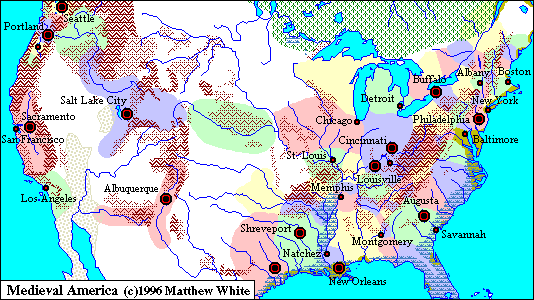
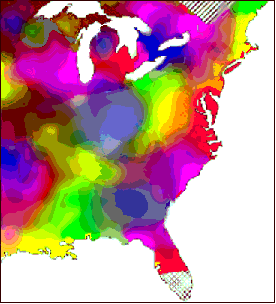
The borders for the East of America, and the West half. Also, this here gives you a good idea on the various borders around the continent. White pointed out that the forest zones could be a disparate patchwork, but I had no idea how much. It seems most balkanized around the Appalachian and Ozark Highlands, though it's also that way in both the Northeast and Northwest. (No surprise there, as they operate as mercantile city-states. I'm most surprised to see New York and parts of Canada have fragmented so. It has caused me to think a lot about Quebec's expansion. Quebec proper is safely tucked away where it has been. But I would think Canada's being broken up might make it subject to conquest. If cowboys can conquer everything in site, I don't know why Quebecois wouldn't. This map displays the language of the region, and while it doesn't confirm anything about Quebec, I do notice New York seems to have a similar gradient as the Ottawa metro-area, so I wouldn't say the theory is shot down. The New York flag has the statue of liberty, which is an American symbol, but it's also a french statue, so...part of me is tempted to abandon the French New York thing, but I don't have anything to truly shout it down yet.
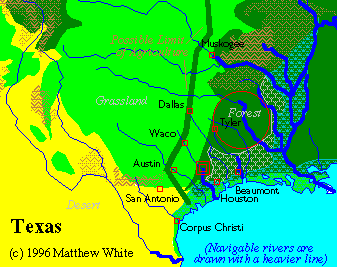
There's a sub-map for the Pacific Northwest, which is titled "Cascadia". The weird thing is, the file name is "pac-northwest", which is what you get from clicking on cities like Seattle and Portland. But it also has the flag for the District of Columbia inside that so...while it doesn't raise an insane amount of questions, I am left to wonder about the formatting, if not the content. I do wonder what the Columbia page is, though, since it seems to be this country without any major cities in it. Also, more of Medieval Texas is explored. White himself has an image for Texas, although I'm unsure what page it would have appeared on. Perhaps the tribal page? In any case, the most eastern of Texas is fused with some of Louisiana and Arkansas to form "Red River Territory", the most western absorbed by new Mexico, and the bulk of it under a tribe named the Andersons, who have nevertheless kept Houston up and running. Generally makes sense for the competing (Dixie, Latino and Plains) cultures,, although I am curious to know how "Texas" plays into any sense of nationalism for the region.
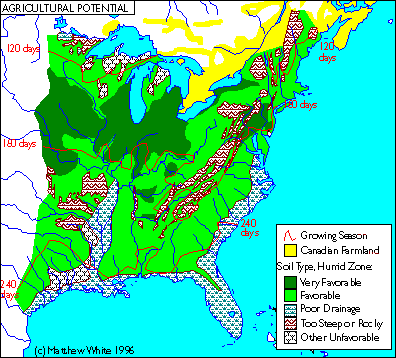
Perhaps the one thing I was way off the mark on about was the Yankees. I think I'm generally correct about what culture is like in the Northeast, but apparently I was incorrect in interpreting the Yankee symbol as a boat (it's a plow), and extrapolating it to be mostly a maritime culture. This probably remains true for the three Northeast nations, it's just that I'm incorrect in assuming the Northeast is distilled "Yankee" culture. Or maybe not, as the icon isn't any further west than Pennsylvania. I do think Ohio and it's four District HQs does give it something common in the Northeast, but it's still arguable as a "Yankee nation". I'm assuming this map would go to that particular page. Unfortunately, there are no other pictures for that "How they would" dress, no for the "Irrigation" (Desert-Dwellers) page, which is unfortunate. I suppose very little I've said on the subject has proven to be wrong, but I do have doubts.
I've mentioned very little of it on this blog, but White does have a page for the Jackelope, which led me to believe other American folklore monsters had one, and I was correct. There are images for Bigfoot, Mothman, the Jersey Devil, and Roswell aliens. That covers most of the American folklore monsters (I suppose Wendigos and Men in Black could be mentioned as well), although I have myself wondered about what other folklore would exist in Medieval America. Christmas Elves? Tooth Fairies? Movie monsters? I do think White covered the most he could while 1) Remaining exclusive to America, and 2) In the public domain. My next post is actually going to touch on how popular culture would fit into American folklore. Interestingly, there is also a file image for Elvis, connected to the confederate flag. (Though I would think him attached to a Tennessee flag) I was also thinking about Elvis before I saw that--he's both a entertainment legend and an urban legend, as he's often mentioned in the same publications as Bigfoot and UFOs, so he probably has some folklore status as well.
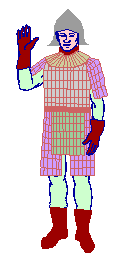
The only figure I did find from White is a Knight, probably for the Lancers page. I...kind of doubt we'd see pastels like that, but I think I see what he's going for here. The armor reminds me a little bit of the Asian grid designs , which combined with some elements we see in European armor, is something pretty unique. Actually, it reminds me of the look the villains from the film version Prince Caspian. I don't know what nation this is from in particular, (Though I imagine it'd be one from the feudal core) and if the knights look different in the desert, in Quebec, if one some of them have more native American motifs, but I have actually been doing some sketches. In any case, it's nice to have a taste of something that obviously plays a big part in the continent.
In general though, this will lead me to go back and clarify questions, and revamp some ideas. At first I was on the mission of suggesting, not telling. Then I got it in my head to just tell, now I may go back and suggest. I suppose I've done as much as I can without actually doing to nations per se. What I'm thinking of doing is creating a wiki for all this. I was hesitant because White hates Wikipedia, and it would feel a little disrespectful, but I think I may have taken this as far as it can go in blog form (at least until I do illustrations), and it's obvious I will have to retouch things over time.
Wednesday, December 9, 2009




Friday, November 6, 2009
New Age
Despite much of the Southwest originally being Catholic in nature, religion in the desert can be a lot like flooding a basin. The isolation means the message gets spread to everybody, and there are not too many outside forces to compete with. That's the nature hydraulic empire--religions can be pretty uniform, easy to enforce, and prone to some very bizarre whims. In the Industrial Age, New Ange movements were informal and de-centralized, and hard to define vagaries. But in the new Middle Ages, most New Age believers were flushed out as heretics, and in the Southwest Hydraulic Emperors tightly guided from a grassroots belief system into a a highly organized and heiarchial one.
In a lot of ways, New Age is like Buddhism. There's a reverence for their Earth, a belief in enlightenment, and a need for purity and meditation. However, in other ways there are complete opposites. Buddhism focuses very much on the earthly surroundings of the natural world, while New Age focuses on the beyond. The clear skies and the somewhat barren landscape have led them to study stars and see them as sacred.
Astrology plays a large role in the religion. The Zodiac is the frame of reference for religious doctrines and practices. Priests are required to study the movement of the stars and planets. Both governor and peasant alike take their horoscopes very serious. Signs will often play a role in the name a child is given, and the career they are apprenticed towards. It's also a large part of matchmaking, as marriages between incompatible signs are a taboo. Many a tragic tale is told over "star-crossed lovers".
Priests have a very active role in the lives of the southwest populace and royal courts. Besides astrology, they are also trained to develop therapeutic teas and massage techniques. They are often charged with healing, which may sometimes rely on herbs, but just as often disease is countered with crystal baths and chanting. In funeral rites, they may place emeralds with departed.
There is a specific priest caste which religious higher ups are born to, but ever now and then they will learn of a child with strange or autistic behavior, who they will induct into their ranks. They are called Indigos, and their jobs usually involve calculating or deciphering mathematical equations, which the priests will interpret the meaning of.
In a lot of ways, New Age is like Buddhism. There's a reverence for their Earth, a belief in enlightenment, and a need for purity and meditation. However, in other ways there are complete opposites. Buddhism focuses very much on the earthly surroundings of the natural world, while New Age focuses on the beyond. The clear skies and the somewhat barren landscape have led them to study stars and see them as sacred.
Astrology plays a large role in the religion. The Zodiac is the frame of reference for religious doctrines and practices. Priests are required to study the movement of the stars and planets. Both governor and peasant alike take their horoscopes very serious. Signs will often play a role in the name a child is given, and the career they are apprenticed towards. It's also a large part of matchmaking, as marriages between incompatible signs are a taboo. Many a tragic tale is told over "star-crossed lovers".
Priests have a very active role in the lives of the southwest populace and royal courts. Besides astrology, they are also trained to develop therapeutic teas and massage techniques. They are often charged with healing, which may sometimes rely on herbs, but just as often disease is countered with crystal baths and chanting. In funeral rites, they may place emeralds with departed.
There is a specific priest caste which religious higher ups are born to, but ever now and then they will learn of a child with strange or autistic behavior, who they will induct into their ranks. They are called Indigos, and their jobs usually involve calculating or deciphering mathematical equations, which the priests will interpret the meaning of.
Thursday, November 5, 2009
Scientology
In the Industrial Era, much of the West Coast was secular in nature, with basic Christian tenets merely informing its lifestyle. From Las Vegas to Los Angeles to San Francisco, much of the regions west of the Rockies had, at best, a tenuous relationship with the country's religious leaders. However, once society slid back into medieval era, people were going to slide back into religion no matter what. All it needed was something to fill the vacuum.
The Church of Scientology started out as a fringe cult fronted by eccentric celebrities. This tended to be a boon when society started devolving. Even though performers have little practical use in a back-to-basic civilization, wealthy performers may have a little more clout. Estates of the rich and famous would be lent out to the peons, and celebrities could maybe amass a few loyal bodyguards. Some may have even had enough foresight to stock up on goods and hide in a personal complex until the worst was over, and they could come out to pick up the pieces.
This is where the Church of Scientology stepped in. Often criticized for its bizarre ideas and scare tactics, the fact was, nothing really stood out as insane as somebody had some kind of out-there religious epiphany on every corner. It's just that the CoS was well-equipped with charismatic and already well-known preachers. Many of the huddled masses even found comfort in familiar faces from better times, and a tightly rigid structure. Sure hierarchy was brutal and treated them as little more than slaves, but this was par for the course everywhere in the desert, so it might as well be them. Laws against detergents and psychiatry mean rather little when they're not around anyway. Criticisms on how credible the back story is also bounce of a populace that is mostly illiterate and superstitious anyways.
While things like Xenu, Thetans and Auditing still exist in the Church, a large amount of the canon has slowly been permuted with what's known as "Hollywood folklore". It's filled with heroes like Indiana Jones, goddesses like Marilyn, wizards like Vader, monsters like Kong, and locales like Casablanca. The Mann's theater is a place to canonize their heroes and saints, and rulers are appointed with a gold statue of a man at their coronation. It's said that upon death, the President of the Church will join his ancestors and become a star in the sky. These figures of Californian mythology appear in a lot of art and sculptures, as the CoS is the largest employer of artisans and masons, and often wish to make their places of worship ornate and easy for the peasants to understand. Californian art and architecture also has a recurring motif of rings and arches.
Interestingly, many of the Holidays of the Church match the Non-Denominational ones. Festivals are held around the same times Thanksgiving, Christmas, and the Fourth of July are in the East, however the celebrations are strictly held to the weekend. There is also a major Memorial Day, to commemorate those destroyed by Xenu. (Because there are not a lot severe winters in California, spring festivals do not feature in Scientology very much. More often Scientologists use spring as a time to discard or use up lesser possessions) These festivals are known for producing large theatrical productions which tell stories of many great heroes and events in the culture. November tends to focus on stories for children, December pageants tell their stories with song, and July presents stories of the most heroic and bombastic feats.
The Church of Scientology started out as a fringe cult fronted by eccentric celebrities. This tended to be a boon when society started devolving. Even though performers have little practical use in a back-to-basic civilization, wealthy performers may have a little more clout. Estates of the rich and famous would be lent out to the peons, and celebrities could maybe amass a few loyal bodyguards. Some may have even had enough foresight to stock up on goods and hide in a personal complex until the worst was over, and they could come out to pick up the pieces.
This is where the Church of Scientology stepped in. Often criticized for its bizarre ideas and scare tactics, the fact was, nothing really stood out as insane as somebody had some kind of out-there religious epiphany on every corner. It's just that the CoS was well-equipped with charismatic and already well-known preachers. Many of the huddled masses even found comfort in familiar faces from better times, and a tightly rigid structure. Sure hierarchy was brutal and treated them as little more than slaves, but this was par for the course everywhere in the desert, so it might as well be them. Laws against detergents and psychiatry mean rather little when they're not around anyway. Criticisms on how credible the back story is also bounce of a populace that is mostly illiterate and superstitious anyways.
While things like Xenu, Thetans and Auditing still exist in the Church, a large amount of the canon has slowly been permuted with what's known as "Hollywood folklore". It's filled with heroes like Indiana Jones, goddesses like Marilyn, wizards like Vader, monsters like Kong, and locales like Casablanca. The Mann's theater is a place to canonize their heroes and saints, and rulers are appointed with a gold statue of a man at their coronation. It's said that upon death, the President of the Church will join his ancestors and become a star in the sky. These figures of Californian mythology appear in a lot of art and sculptures, as the CoS is the largest employer of artisans and masons, and often wish to make their places of worship ornate and easy for the peasants to understand. Californian art and architecture also has a recurring motif of rings and arches.
Interestingly, many of the Holidays of the Church match the Non-Denominational ones. Festivals are held around the same times Thanksgiving, Christmas, and the Fourth of July are in the East, however the celebrations are strictly held to the weekend. There is also a major Memorial Day, to commemorate those destroyed by Xenu. (Because there are not a lot severe winters in California, spring festivals do not feature in Scientology very much. More often Scientologists use spring as a time to discard or use up lesser possessions) These festivals are known for producing large theatrical productions which tell stories of many great heroes and events in the culture. November tends to focus on stories for children, December pageants tell their stories with song, and July presents stories of the most heroic and bombastic feats.
Wednesday, November 4, 2009
Voodoo
The Northeast of America has always had a somewhat adversarial relationship with the rest of the country. Further west, the Non-Denominational Church has been essentially rejected. In the south, the Church districts are farther and farther apart, and nations pay less and less attention to what the Supreme Court has to say. Religion has been relatively unorganized and independent, and typical evangelist congregations have been supplanted by Voodoo along the Gulf Coast.
There are a couple of other reasons for the spread of Voodoo. Besides the growing infusion of Caribbean culture, the more African descended population may have felt more of a kinship than religion dominated by the ethnically different Yankees. Its spread also has a lot to due with the presence of Secretarial States. Women are given a prominent role in the bureaucracy and stability of the deep south, because the men are off fighting, fishing or doing merchant work. With males usually away, women were also left to their own devices in the field of worship. As Louisiana Voodoo is a faith that gives women a prominent role, it seemed like a pretty natural fit. Spiritual leaders called Voodoo Queens can provide the spiritual needs of the community. It's also a reflection of the Non-Denom church performing the bureaucratic services of its territory. Since the bureaucracies of the Gulf Coast are made up of women, women might as well be helping out with the religious duties. Schools are taught in Creole, medicine is administered by priestesses, and whatever passes for Voodoo organization keeps track of will and deeds. Voodoo Queens may also play a part in the royal family's linage.
Because property is passed from father-in-law to son-in-law, there's less of a pressure to produce male heirs. If the queen gives birth to a boy, that's great, and makes things a little more straightforward. But if it's a girl, she's simply trained to be a High Queen, and they look for a worthy bridegroom among the noble families. Heritage is matrilineal anyways, and this allows the father's direct line to at least play some part in the authority of the state. This of course, has led to a lot of politicking and abuse in its own right, but the point is, nothing short of infertility will cause a succession crisis.
By the way, the presence of Voodoo Queens in the royal family make these states, in theory, theocracies, but the very informal nature prevents secular and religious conflicts of interest. Voodoo leaders are more or less charged with organizing and performing rites, or divinations. There isn't a particular lot of dogma to create schisms with anyways. But that's not to say rulers haven't used to to their advantage.
In some ways,Voodoo does resemble Catholicism, with the importance of Christ and much of the pageantry. However, the Voodoo Church is in many ways quite divergent with the Non-Denominational Church, and only moreso as the two faiths have canonized different saints over the years. Marie Laveau is there most important figure. Voodoo also uses widely different symbols (aside from the cross), with imagery like snakes, skulls and card motifs. Combined with the language, rites, and prominence of women, Non-Denoms view Voodoo practitioners as little more than pagans, and nations like Mississippi and Red River have found themselves embroiled in furious religious wars for Louisiana.
There are a couple of other reasons for the spread of Voodoo. Besides the growing infusion of Caribbean culture, the more African descended population may have felt more of a kinship than religion dominated by the ethnically different Yankees. Its spread also has a lot to due with the presence of Secretarial States. Women are given a prominent role in the bureaucracy and stability of the deep south, because the men are off fighting, fishing or doing merchant work. With males usually away, women were also left to their own devices in the field of worship. As Louisiana Voodoo is a faith that gives women a prominent role, it seemed like a pretty natural fit. Spiritual leaders called Voodoo Queens can provide the spiritual needs of the community. It's also a reflection of the Non-Denom church performing the bureaucratic services of its territory. Since the bureaucracies of the Gulf Coast are made up of women, women might as well be helping out with the religious duties. Schools are taught in Creole, medicine is administered by priestesses, and whatever passes for Voodoo organization keeps track of will and deeds. Voodoo Queens may also play a part in the royal family's linage.
Because property is passed from father-in-law to son-in-law, there's less of a pressure to produce male heirs. If the queen gives birth to a boy, that's great, and makes things a little more straightforward. But if it's a girl, she's simply trained to be a High Queen, and they look for a worthy bridegroom among the noble families. Heritage is matrilineal anyways, and this allows the father's direct line to at least play some part in the authority of the state. This of course, has led to a lot of politicking and abuse in its own right, but the point is, nothing short of infertility will cause a succession crisis.
By the way, the presence of Voodoo Queens in the royal family make these states, in theory, theocracies, but the very informal nature prevents secular and religious conflicts of interest. Voodoo leaders are more or less charged with organizing and performing rites, or divinations. There isn't a particular lot of dogma to create schisms with anyways. But that's not to say rulers haven't used to to their advantage.
In some ways,Voodoo does resemble Catholicism, with the importance of Christ and much of the pageantry. However, the Voodoo Church is in many ways quite divergent with the Non-Denominational Church, and only moreso as the two faiths have canonized different saints over the years. Marie Laveau is there most important figure. Voodoo also uses widely different symbols (aside from the cross), with imagery like snakes, skulls and card motifs. Combined with the language, rites, and prominence of women, Non-Denoms view Voodoo practitioners as little more than pagans, and nations like Mississippi and Red River have found themselves embroiled in furious religious wars for Louisiana.
Monday, October 12, 2009
Canadian Raiders
The colder regions are populated by those often called Barbarians. Out west, it's dominated mainly by cowboy horse archers, but north of the great lakes, grain and grass is too little, and the terrain too tough for large cavalry forces to be formed. The hunter-gatherers centered around the Canadian lakes have much less resources, and much more fury. Many travel the land to raid nearby villages, but it's very common to build barges for rivers and lakes, to attack kingdoms like Wisconsin, Michigan and others. They are somewhat similar to viking ships of old, except more equipped for freshwater travel. They're smaller, but provide less buoyancy, so barges are designed to hold a good amount of weight and make trips over the summer season.
The Canuck raiders are feared largely because of their size. Like other Barbarian societies, pretty much the entirety of the adult males are drafted into campaigns of war. They're hardened by the long winters and a belief in might. They often venerate powerful beasts like bears and wolves, and will often dress themselves in such skins to gain their powers. Their faces are also painted red, a sacred and mystical color in the north.
Naval Forces
The Americas are rather strange, in that there is not a large amount of of seas that cut through it. This is probably the biggest thing that distinguishes it from the Europe it draws so much from, culturally. The major military naval bases are found on the Atlantic Seaboard, Vancouver Sound, the Gulf of Mexico, and the Caribbean sea. The Gulf of St. Lawrence and Labrador Sea are generally too cold and sparsely populated for major battles to be waged there. However, the Great Lakes tend to serve as something of a de facto sea, with kingdoms guarding the canals that connect them. There's also the Mississippi River, which connected to both the Ohio and Missouri ultimately provides something of an interstate for the feudal core. Largely, the river system is used for trade, but it's very common for warlords to create river barges to raid these ships, or blockade them for ransom. However, these are generally means to and end, and not a lot naval strategy is used for them.
There are no missiles, or even canon fire anymore, so fleets have only the most basic of ancient projectiles at their disposal. However some allow themselves to be pretty inventive. Even though the ships don't resemble the large galleons of the age of exploration, they're relatively sophisticated, as coastal cities were able to at least glean some knowledge from the past, and have a fundamental understanding of nautical schematics.
The United States is the supreme naval power of the coast, with most ships of the Northern Atlantic trying to copy their jealously guarded designs. here, ships are made for longevity, and the ability to hold heavy cargoes. Marine soldiers are taught mostly endurance, for both the long winters and the long voyages. Northern ships have sturdy, thick hulls which are able to provide decent (by the standards of the time, anyways) barracks for the soldiers.
In the Caribbean and Gulf, warfare is played a lot like "capture the castle", which involves conquering and securing various island port bases. If fleet is particularly good at what they do, they can have islands full of provisions and weaponry for years to come. Many islands however, are full of leftovers from eradicated fleets who took their secrets with them to the bottom of the ocean. The heavy rains and winds of hurricane season means ships are made from more flexible, durable wood--usually balsa. One of the favored techniques of the Caribbean is to shoot fiery arrows at the ship.
Lake Navies are somewhat part time, as the winter freezes the waterways, leaving them to only b engage each other other during the summer. This lakes can also not hold as much weight. As a result, naval battles in the Great Lakes turn largely into all-or-nothing bloodbaths, attempting to storm forts as soon as they can, and do as much damage to the other ship as possible. Siege weapons such as trebuchets are sometimes even mounted to ships, resulting in a heavy amount of collateral damage on the "Drinking Sea".
There are no missiles, or even canon fire anymore, so fleets have only the most basic of ancient projectiles at their disposal. However some allow themselves to be pretty inventive. Even though the ships don't resemble the large galleons of the age of exploration, they're relatively sophisticated, as coastal cities were able to at least glean some knowledge from the past, and have a fundamental understanding of nautical schematics.
The United States is the supreme naval power of the coast, with most ships of the Northern Atlantic trying to copy their jealously guarded designs. here, ships are made for longevity, and the ability to hold heavy cargoes. Marine soldiers are taught mostly endurance, for both the long winters and the long voyages. Northern ships have sturdy, thick hulls which are able to provide decent (by the standards of the time, anyways) barracks for the soldiers.
In the Caribbean and Gulf, warfare is played a lot like "capture the castle", which involves conquering and securing various island port bases. If fleet is particularly good at what they do, they can have islands full of provisions and weaponry for years to come. Many islands however, are full of leftovers from eradicated fleets who took their secrets with them to the bottom of the ocean. The heavy rains and winds of hurricane season means ships are made from more flexible, durable wood--usually balsa. One of the favored techniques of the Caribbean is to shoot fiery arrows at the ship.
Lake Navies are somewhat part time, as the winter freezes the waterways, leaving them to only b engage each other other during the summer. This lakes can also not hold as much weight. As a result, naval battles in the Great Lakes turn largely into all-or-nothing bloodbaths, attempting to storm forts as soon as they can, and do as much damage to the other ship as possible. Siege weapons such as trebuchets are sometimes even mounted to ships, resulting in a heavy amount of collateral damage on the "Drinking Sea".
Tuesday, October 6, 2009
Pikemen Infantry
To a certain extent, medieval warfare plays a lot like a game of rock paper scissors, with armies evolving to counter the biggest and nearest threats. To counter the lancers of the feudal kingdoms, many nations arm their soldiers with large sharp pikes, which can form a sharp defensive wall that most cavalry can't reach, or hope to trot over. Pikemen are largely the citizens of the the northern, coastal nations. Cavalry is much too expensive to maintain where the soil can be much more limited. Likewise, because large communities are so close together, it's more important to feed people than horses. The close consolidation of people also pretty much means speed is not as much of a factor. A mobile infantry can probably move from one outpost to another without much trouble. If they can't, there's always the nearby ocean. In fact, the focus on maritime transport pretty much means captains don't want too many knights, as horses on ships pretty much just complicate things.
It's not to say there are no mounted troops in the Republics--a few high ranking officers are cavalry, if for no other reason than to show off. It's just these nations don't particularly engage in feudal warfare, and are more concerned with being on the defensive.
Because most of them are ruled by mercantile families, not warlords, there tend not to be citizens who were born and bred for combat. The city-states will conscript private citizens for service, and these citizens are given relatively simple training and equipment. For Pikemen to be effective, one simply needs a large pool and leaders with an ability to look at the big picture. City-states will even have a very strong municipal guard force, who are generally equipped the same way, and maybe even bear similar uniforms as the infantry.
Interestingly, despite it being feudal in nature, New Jersey relies more on a pikemen force than knights. New Jersey is largely in the same place as the bustling northern cities, with a large population fitting into a relatively small piece of land, as its realm includes counties that had the highest population density in the country. It only has a few major cities and counties, and they're not widely dispersed from each other, so there's very little need for warlords to mount themselves and reconnoiter the countryside. It also has access to the oceans, so it likewise focuses on sending its infantry. However, the Pikemen here are relatively more ornate, especially the guard captains.
Pikemen have also taken root in the highlands of the Appalachian mountains. Here, the people are usually not wealthy enough for mounted knights, nor is it advantageous for the altitudes. Rather, they're large wooden polearms held by clan militias. The mountain fighters are quite different from the other pike-holders, as they're not really uniformed. conscripted armies, but clans bound together by loyalty. Here, pikemen have firm, lightweight wood polearms, which some have even taken to throwing like javelins. Appalachian forts are also known to surround themselves with "pike moat" traps.
It's not to say there are no mounted troops in the Republics--a few high ranking officers are cavalry, if for no other reason than to show off. It's just these nations don't particularly engage in feudal warfare, and are more concerned with being on the defensive.
Because most of them are ruled by mercantile families, not warlords, there tend not to be citizens who were born and bred for combat. The city-states will conscript private citizens for service, and these citizens are given relatively simple training and equipment. For Pikemen to be effective, one simply needs a large pool and leaders with an ability to look at the big picture. City-states will even have a very strong municipal guard force, who are generally equipped the same way, and maybe even bear similar uniforms as the infantry.
Interestingly, despite it being feudal in nature, New Jersey relies more on a pikemen force than knights. New Jersey is largely in the same place as the bustling northern cities, with a large population fitting into a relatively small piece of land, as its realm includes counties that had the highest population density in the country. It only has a few major cities and counties, and they're not widely dispersed from each other, so there's very little need for warlords to mount themselves and reconnoiter the countryside. It also has access to the oceans, so it likewise focuses on sending its infantry. However, the Pikemen here are relatively more ornate, especially the guard captains.
Pikemen have also taken root in the highlands of the Appalachian mountains. Here, the people are usually not wealthy enough for mounted knights, nor is it advantageous for the altitudes. Rather, they're large wooden polearms held by clan militias. The mountain fighters are quite different from the other pike-holders, as they're not really uniformed. conscripted armies, but clans bound together by loyalty. Here, pikemen have firm, lightweight wood polearms, which some have even taken to throwing like javelins. Appalachian forts are also known to surround themselves with "pike moat" traps.
Subscribe to:
Posts (Atom)