
The people on the alternate history boards have speculated on what the rest of the world looks like. I haven't spent too much time on that, because as White wrote
"In most of the world, the New Middle Ages were merely a rerun of the Old Middle Ages. In England and Japan, the constitutional monarchies dumped their constitutions. Europeans turned again to the Roman Catholic Church for guidance. Camels plodded along the caravan routes of the Middle East, bringing silk from China and pilgrims to Mecca, just as they did a thousand years ago"
It should be reiterated that medieval America is amazingly unique. So in much of the Old World, there would not be many changes. Maybe some states, or languages we didn't see from 1000-1500, maybe even new world crop or two made it over, but somebody from then would recognize this world. The knights and castles of Europe, the empires of the east. Africa would also likely resemble its pre-modern period, as people don't realize how sophisticated Africa was before it got plundered for slaves and resources. Spain, Russia, and Japan might stretch the confines of "medieval", as they would probably be more like their 1500 selves than anything, but still in that zone. Perhaps the hardest bell to unring would Australia, although even then, with its size and climate resembling places like California and Texas, would not be more than three million at the most. Also, it would be unrecognizable as Australia, because it would be so isolated from the rest of the Western world. But between the completely alien and the back to basics would be Latin America.
It should be said Latin America may not even be applicable as a concept. Spanish and Portuguese are definitely unlikely to be spoken in vernacular at this point, although the Catholic Church, depending on how prominent could possibly throwback to Latin as a means of communication, keeping all the nations roughly in the Romance language sphere. Thus, Latin America could conceivably mean "Catholic America". This would be very interesting, since it's hinted many Caribbean Islands now practice Voodoo. The Caribbean is already a mix of Spanish, French and English speakers, and its largest Latin American nation, Cuba, is relatively irreligious, so, perhaps like the west coast, would be rife for mass conversions. Thus the Caribbean would probably not be considered Latin America in any sense, although that's still four million or so people at the most.
We do know that upper Mexico is Catholic, and this would be the deserts that are fairly isolated and border the former United States, so I think it would be fair to assume the the Catholic influence only intensifies as we go to the core of the country. The that ranges from Mexico to Colombia and South America is known as "The Spanish Main", and it is the oldest colonized region of North America, starting back from the early 16th century. As a result, it's not too far removed from the Middle Ages, and thus Colonial Mexico probably does not look dissimilar from how it looked back then. If anything, the resemblance might be closest to late antiquity, with governors or viceroys administering on behalf of a distant monarch. Of course, there is no distant monarch now, and with the reemergence of the Church, which owned most of the land in the original colonial period, as a stabilizing force, there's definitely reason to believe a neo-Medieval period wouldn't be too different from its colonial period.
The western part of South America may even more strongly resemble its 16th century counterpart. The last time the U.S. had a population equal to that of Medieval America, it was the 1880's. The 1880's also saw the former nations of the Inca Empire reach the population it had at the Inca's zenith, so overall, this looks to be a pretty good model for New World medieval countries. While we would not see a reborn Inca empire, the topography of Peru and its neighbors prevented the conquistadors from taking too heavy a hand when governing or transforming the culture. Quechaun is the most widespread Indiginous tongue, and so one can easily see that being the common populace's language, while a Latin warrior class rules over them. Not so different from say, Norman-conquered England.
I would believe that interior South America, particular the Amazon would revert to as much pre-Colombian tribalism as possible. Even the industrial age was never able to make inroads into the Amazon basin, and it would only be more difficult without machines or guns or infrastructure.The Guyana area was always underpopulated anyways.
The most radical change would be on the Southern Cone--Brazil, Argentina, Uruguay. This is were the Native population never really recovered or intermarried with the settlers, or were even around in the first place. This is also the "breadbasket" of Latin America, so we're looking at a strong agricultural product.
Saturday, January 30, 2010

Wednesday, January 20, 2010
Folklore
White's site primarily focuses on history/realism. not the fantastic. (I mean, besides the very premise of the site.) However, whenever we think of medieval times, we're less inclined to think of the real figures and politics, and more of the fairy tale version of it. With the possible exception of (A very broadly conflated version of) the ancient Middle East no region/era has been more associated with magic over real history than Medieval Europe. Perhaps this may be the result of J.R.R. Tolkien, whom most fantasy fiction draws from, placing his universe in a Medieval European setting. It may have been Walt Disney. But ultimately, this creates the temptation to ponder what the fantasy version of Medieval America is like, either when extrapolating what myth and folklore exists, or wanting to set some kind of role playing campaign in it. As I've said, White doesn't get into this much--he seems to primarily want to focus on the somewhat real. Plus, it's very easy to get taken over by popular culture, which I'll get to later.
He does delve a little into what imaginary beasts people might come up with. Almost hidden on the Herdsmen page is a link to the Jackelope, an imaginary animal that is a rabbit with antlers. Looking in the archives, you see four more monsters have been cooked up. From the Appalachians, you have Mothman. From the mid-Atlantic, the Jersey Devil. From the Southwest, you have a Roswell Alien. And of course, from the Northwest, Bigfoot. These are essentially cryptids; Creatures that have not been proven to exist, but have attracted sightings and claims that they're very real.
1) That we came from a society that simply does not believe in elves or goblins, and it's hard to go back. With the exception of the Jackelope, many people do believe in these creatures, or at least more than other fantastic creatures. So it could be something like "Unicorns are ridiculous, but Jersey Devils, that's something to be afraid of!"
2) Regional issues. A lot of mythical creatures that are in the popular lexicon like elves and trolls simply come from across the sea. So it may have been White's intention to focus on the creatures that emerged from American folklore.
3) Public domain. Would we believe in things like Wookies and Predators in the future? Perhaps, but that might cause legal problems. I would have also guessed at first that White wanted to steer clear of things with Industrial Age connotations except for the Alien-like being ruled that out.
So here we are, ready to flesh out what folk beliefs in legends exist in Medieval America. I suppose we could divide it all into three categories. Public domain, modern characters, and real world figures.
The first part would be the folklore figures. As mentioned, we got into the strange cryptid things. Some of the creatures from American folklore and urban legends include the Goatman, the Hodag and the Squonk. It's also possible Native American myths like the Wendigo, and the Thunderbird persist. And finally, much of the Caribbean folklore (Which would be brought along with Voodoo) would make its way to the gulf. It's too extensive to get in there too. And then there are the heroes. Paul Bunyan, Pecos Bill, John Henry, Zorro, and the like may catch on.
Some of the people featured in tall tales are actually real, like Calamity Jane. Daniel Boone, Davey Crockett and countless others have gained folk hero status, and could probably survive, especially in Texas and the mountain states. Paul Revere might remain an important hero in the Northeast. Many presidents and founding fathers could conceivably play a big role, but there might be too many records of them to truly retain "folk" status. I imagine the major presidents like Washington and Lincoln will still remain known, however. Sports heroes may also become mythic figures, although mostly the ones who truly symbolized their field like Wayne Gretsky and Michael Jordan. Granted, many athletes tend not to stand the test of time, but in America we've really hyped the people up. Will the centuries turn them into warriors? Give them magic powers?
Movie stars would be an interesting case. I've pointed out California would likely canonize Hollywood figures. Probably not a lot of actors would be famous as historical or folk characters. Maybe a few who were personified as a certain type like Clint Eastwood. Likely a few tragic ones like Marilyn Monroe. And maybe any that went on to be high profile historical leaders like Arnold Schwarzenegger. Musicians might sift more in the tides of time, except those with a cult of personality all their own. White had an image of Elvis on his site, so it's very possible he would work himself into the folklore of this age.
Literary characters like Tom Sawyer and the headless Horsemen might exist as legends. I think the fictional work with the biggest penetration would possibly be the Wizard of Oz. The Wicked Witch, the Yellow Brick Road, the Ruby Slippers. Star Wars is another of the quintessential myths of America. Other than the Wizard of Oz and perhaps Batman, it has the most characters and paraphernalia that are known to the average person on the street. I have theorized that Star Wars may potentially have a stronger reach in the West than the East, but who knows if the story
But speaking of Batman, a part of me thinks comic book superheroes might be the bread and butter of American mythology--many have theorized it's already the case. Superman and batman have the most mythic elements besides themselves to be part of the public consciousness. Villains, kryptonite, the bat-signal, etc. I think other characters that would appear, in order of likeliness, would be Spider-Man, Wonder Woman, The Hulk and Wolverine. (The last in particular around the Canadian regions) After that, I think we may see characters that fill niches, but may not be the same one. For instance a stretchy guy, a fire guy, that sort if thing. The may have continental popularity, but it wouldn't surprise me to see characters catch on in certain regions more than others. I can't help but think Superman in particular would be a symbol of the very American states.
What are other characters and heroes that would filter through the centuries? I mean, just think about how we have so many stories simply in a 100 years. Do we expect it all to last? Indiana Jones, I think could exist. Perhaps Buffy the Vampire Slayer. Even if the character has not become a major media franchise, she's probably the most well known of monster vanquishers. Perhaps something akin to James Bond, but filtered through a very American lens. (Absorbed into Jason Bourne? Jack Bauer?) In mind, the most enduring would be slasher monsters like Freddy Kruger, Jason Voorhes, the Alien, the Predator. Basically because they feel like such natural fits to previous folk stories. I've noticed the monsters of 80's horror movies seem to slaughter lustful teenagers or greedy corporations. Like morality plays on the seven deadly sins or something.
What's truly the rub with mythology, things don't stay exactly the same for hundreds of years. Would you believe Robin Hood, Maid Marian and Friar Tuck were their own separate legends, before being pooled together in one? So I've tried to be absolutely vague, and I suppose later I could come up with a more streamlined vision. But this has been what's been going in my head.
He does delve a little into what imaginary beasts people might come up with. Almost hidden on the Herdsmen page is a link to the Jackelope, an imaginary animal that is a rabbit with antlers. Looking in the archives, you see four more monsters have been cooked up. From the Appalachians, you have Mothman. From the mid-Atlantic, the Jersey Devil. From the Southwest, you have a Roswell Alien. And of course, from the Northwest, Bigfoot. These are essentially cryptids; Creatures that have not been proven to exist, but have attracted sightings and claims that they're very real.
1) That we came from a society that simply does not believe in elves or goblins, and it's hard to go back. With the exception of the Jackelope, many people do believe in these creatures, or at least more than other fantastic creatures. So it could be something like "Unicorns are ridiculous, but Jersey Devils, that's something to be afraid of!"
2) Regional issues. A lot of mythical creatures that are in the popular lexicon like elves and trolls simply come from across the sea. So it may have been White's intention to focus on the creatures that emerged from American folklore.
3) Public domain. Would we believe in things like Wookies and Predators in the future? Perhaps, but that might cause legal problems. I would have also guessed at first that White wanted to steer clear of things with Industrial Age connotations except for the Alien-like being ruled that out.
So here we are, ready to flesh out what folk beliefs in legends exist in Medieval America. I suppose we could divide it all into three categories. Public domain, modern characters, and real world figures.
The first part would be the folklore figures. As mentioned, we got into the strange cryptid things. Some of the creatures from American folklore and urban legends include the Goatman, the Hodag and the Squonk. It's also possible Native American myths like the Wendigo, and the Thunderbird persist. And finally, much of the Caribbean folklore (Which would be brought along with Voodoo) would make its way to the gulf. It's too extensive to get in there too. And then there are the heroes. Paul Bunyan, Pecos Bill, John Henry, Zorro, and the like may catch on.
Some of the people featured in tall tales are actually real, like Calamity Jane. Daniel Boone, Davey Crockett and countless others have gained folk hero status, and could probably survive, especially in Texas and the mountain states. Paul Revere might remain an important hero in the Northeast. Many presidents and founding fathers could conceivably play a big role, but there might be too many records of them to truly retain "folk" status. I imagine the major presidents like Washington and Lincoln will still remain known, however. Sports heroes may also become mythic figures, although mostly the ones who truly symbolized their field like Wayne Gretsky and Michael Jordan. Granted, many athletes tend not to stand the test of time, but in America we've really hyped the people up. Will the centuries turn them into warriors? Give them magic powers?
Movie stars would be an interesting case. I've pointed out California would likely canonize Hollywood figures. Probably not a lot of actors would be famous as historical or folk characters. Maybe a few who were personified as a certain type like Clint Eastwood. Likely a few tragic ones like Marilyn Monroe. And maybe any that went on to be high profile historical leaders like Arnold Schwarzenegger. Musicians might sift more in the tides of time, except those with a cult of personality all their own. White had an image of Elvis on his site, so it's very possible he would work himself into the folklore of this age.
Literary characters like Tom Sawyer and the headless Horsemen might exist as legends. I think the fictional work with the biggest penetration would possibly be the Wizard of Oz. The Wicked Witch, the Yellow Brick Road, the Ruby Slippers. Star Wars is another of the quintessential myths of America. Other than the Wizard of Oz and perhaps Batman, it has the most characters and paraphernalia that are known to the average person on the street. I have theorized that Star Wars may potentially have a stronger reach in the West than the East, but who knows if the story
But speaking of Batman, a part of me thinks comic book superheroes might be the bread and butter of American mythology--many have theorized it's already the case. Superman and batman have the most mythic elements besides themselves to be part of the public consciousness. Villains, kryptonite, the bat-signal, etc. I think other characters that would appear, in order of likeliness, would be Spider-Man, Wonder Woman, The Hulk and Wolverine. (The last in particular around the Canadian regions) After that, I think we may see characters that fill niches, but may not be the same one. For instance a stretchy guy, a fire guy, that sort if thing. The may have continental popularity, but it wouldn't surprise me to see characters catch on in certain regions more than others. I can't help but think Superman in particular would be a symbol of the very American states.
What are other characters and heroes that would filter through the centuries? I mean, just think about how we have so many stories simply in a 100 years. Do we expect it all to last? Indiana Jones, I think could exist. Perhaps Buffy the Vampire Slayer. Even if the character has not become a major media franchise, she's probably the most well known of monster vanquishers. Perhaps something akin to James Bond, but filtered through a very American lens. (Absorbed into Jason Bourne? Jack Bauer?) In mind, the most enduring would be slasher monsters like Freddy Kruger, Jason Voorhes, the Alien, the Predator. Basically because they feel like such natural fits to previous folk stories. I've noticed the monsters of 80's horror movies seem to slaughter lustful teenagers or greedy corporations. Like morality plays on the seven deadly sins or something.
What's truly the rub with mythology, things don't stay exactly the same for hundreds of years. Would you believe Robin Hood, Maid Marian and Friar Tuck were their own separate legends, before being pooled together in one? So I've tried to be absolutely vague, and I suppose later I could come up with a more streamlined vision. But this has been what's been going in my head.
Wednesday, December 16, 2009
Borders
While looking through the image archive, I discovered certain files with "bar" attached. It was then I went back and realized most of the pages on the site were bordered with certain designs. It was a nice little touch that may have gone unnoticed, and it was interesting to see where certain regions had a recurring theme. This may have just been something to do for fun, but I think it also hints at the kind of aesthetics these different regions may have. I think the fringes of clothing and jewelry would very much reflect their bars, so it does warrant some looking into, should one seek to do artwork based on White's world.
White had two general borders, a "keybar" and one that was a shrunken down version of the main map. However, the rest seemed to generally reflect the religion of the area. (Which once again, I point to jewelry and the like) One border which would probably only get play for one page is the Jewish one. I actually haven't touched too much on real religion on this site, but I think this means the story of Jews in Medieval America might have been an interesting one from White.
All the pages pertaining to cowboys have a border that includes quilted looking arrow designs. White already knocked out three pages with this culture, with Tribalism being the only unfinished article that this border would likely belong too. However, since the Rizzini flag is in the archives, and there are two herdsmen territories, they may had pages created for them with this particular border. Whatever page the Texas map would go to (Which would probably be one of the aforementioned pages) would likely get it as well.
The most used border is, and probably would continue to be, the "fubar", which has the design of the cross on it. It's seen on the page for the Non-Denominational Church, the USA, and Iowa. We probably would have seen it on the nations that made up the Northeast, the Great Lakes, and a few southern nations. (I'm guessing anywhere between seven and ten nation pages) Quebec may get the border as well. Even though its something of a quirk on the map, it's not mutually unintelligible with the rest of Eastern culture. I would also take a stab that Feudalism would get the cross border, as with a few frontier exceptions, the feudal states tend to practice Non-Denom. It's a little less exclusive with the Knights, but I would bet they get that border as well.
The "loop" bar may have been the second most common "culture" bar. So far we've seen it with all the desert-based pages. The Hydraulic Empire page has this motif. Both California and Deseret are given this design as well, and it's pretty certain their corresponding religions would have been bordered. And there's a good chance the Irrigation page would have would have had this border too. But not certain.
Because looking around, an unused design called the "nmex" bar shows up. which very clearly has a quilted southwestern feel to it. This would pretty certainly go on the page for New MExico and New Age, but it seems strange to split the desert nations up. But I suppose this it's there to make the distinction between the more "anglo" desert people of California and Utah, as opposed to the more Hispanic/native culture we're going to find down south. The irrigation page could go on either page, but the New Mexico motif may get custody of that one, to generally keep up with an at-least three-per-page ratio we're going with here.
On both the Secretarial States and Southern Farmer pages, we have a border which is referred to in the archives as the "snake bar". Pretty much makes sense since it's already associated with two of the other pages that make up the culture of the Gulf, of which Voodoo is the prominent religion. It's certain that would have gone onto the Voodoo page. (Especially since, once again, relgion seems to be a driving force behind the bars) As to what individual countries the snake bar would have bordered, Louisiana is the only sure thing. It's certainly possible it would have gone on the Southern Front or the Deep South page, but we can't be sure. As mentioned in other articles, the transition from northern to southern culture is gradual, and Georgia might not necessarily have much in common culturally with the Gulf.
And then we have the "northwest" bar, found here. As you can see, a pretty clear yin-yang marks the center, but if you put it in bar form, you see both crosses and moon crescents. This may be a coincidence and White was playing with abstract designs, but this may indicate how much Cascadian Buddhism may differ from its counterpart from across the Pacific. Obviously we'd have the Buddhism page with this border, and the District of Columbia page. But I don't know how many we have beyond that. First, I don't know if the Northwest merchants get their own page. But the rest of the icons the Northwest gets have Northeast counterparts. On both the Government and Warfare maps "Republic" and "Pikemem" are both shown on the Northwest corner. And this map shows that, if there isn't a higher population of pikemen and republics in the Northwest, they play a bigger proportional role than they do in the East.
I don't know what the make iof the oklbar. Looking it up, the only references I could find were Oklahoma and a town in Minnesota, both which are kind of politically banished in this age. I suppose going with the relgion theme, it might go with the "heresy" pages, of which there are two. It might have been an orphaned page for "Here be monsters".
White had two general borders, a "keybar" and one that was a shrunken down version of the main map. However, the rest seemed to generally reflect the religion of the area. (Which once again, I point to jewelry and the like) One border which would probably only get play for one page is the Jewish one. I actually haven't touched too much on real religion on this site, but I think this means the story of Jews in Medieval America might have been an interesting one from White.



All the pages pertaining to cowboys have a border that includes quilted looking arrow designs. White already knocked out three pages with this culture, with Tribalism being the only unfinished article that this border would likely belong too. However, since the Rizzini flag is in the archives, and there are two herdsmen territories, they may had pages created for them with this particular border. Whatever page the Texas map would go to (Which would probably be one of the aforementioned pages) would likely get it as well.

The most used border is, and probably would continue to be, the "fubar", which has the design of the cross on it. It's seen on the page for the Non-Denominational Church, the USA, and Iowa. We probably would have seen it on the nations that made up the Northeast, the Great Lakes, and a few southern nations. (I'm guessing anywhere between seven and ten nation pages) Quebec may get the border as well. Even though its something of a quirk on the map, it's not mutually unintelligible with the rest of Eastern culture. I would also take a stab that Feudalism would get the cross border, as with a few frontier exceptions, the feudal states tend to practice Non-Denom. It's a little less exclusive with the Knights, but I would bet they get that border as well.

The "loop" bar may have been the second most common "culture" bar. So far we've seen it with all the desert-based pages. The Hydraulic Empire page has this motif. Both California and Deseret are given this design as well, and it's pretty certain their corresponding religions would have been bordered. And there's a good chance the Irrigation page would have would have had this border too. But not certain.

Because looking around, an unused design called the "nmex" bar shows up. which very clearly has a quilted southwestern feel to it. This would pretty certainly go on the page for New MExico and New Age, but it seems strange to split the desert nations up. But I suppose this it's there to make the distinction between the more "anglo" desert people of California and Utah, as opposed to the more Hispanic/native culture we're going to find down south. The irrigation page could go on either page, but the New Mexico motif may get custody of that one, to generally keep up with an at-least three-per-page ratio we're going with here.

On both the Secretarial States and Southern Farmer pages, we have a border which is referred to in the archives as the "snake bar". Pretty much makes sense since it's already associated with two of the other pages that make up the culture of the Gulf, of which Voodoo is the prominent religion. It's certain that would have gone onto the Voodoo page. (Especially since, once again, relgion seems to be a driving force behind the bars) As to what individual countries the snake bar would have bordered, Louisiana is the only sure thing. It's certainly possible it would have gone on the Southern Front or the Deep South page, but we can't be sure. As mentioned in other articles, the transition from northern to southern culture is gradual, and Georgia might not necessarily have much in common culturally with the Gulf.

And then we have the "northwest" bar, found here. As you can see, a pretty clear yin-yang marks the center, but if you put it in bar form, you see both crosses and moon crescents. This may be a coincidence and White was playing with abstract designs, but this may indicate how much Cascadian Buddhism may differ from its counterpart from across the Pacific. Obviously we'd have the Buddhism page with this border, and the District of Columbia page. But I don't know how many we have beyond that. First, I don't know if the Northwest merchants get their own page. But the rest of the icons the Northwest gets have Northeast counterparts. On both the Government and Warfare maps "Republic" and "Pikemem" are both shown on the Northwest corner. And this map shows that, if there isn't a higher population of pikemen and republics in the Northwest, they play a bigger proportional role than they do in the East.


I don't know what the make iof the oklbar. Looking it up, the only references I could find were Oklahoma and a town in Minnesota, both which are kind of politically banished in this age. I suppose going with the relgion theme, it might go with the "heresy" pages, of which there are two. It might have been an orphaned page for "Here be monsters".

Wednesday, December 9, 2009
It seems jmberry on the Alternate History Boards discovered a stash of images on White's site that he never got around to using. Needless to say, this cuts down on a bit of my speculation, and some major revisions are in order. In some respects, I was probably not as off on the mark as I would have thought, in others, very. I don't know whether I should go back and revise past posts, or start new ones. In any case, the discoveries have given me a lot to think about.
The borders for the East of America, and the West half. Also, this here gives you a good idea on the various borders around the continent. White pointed out that the forest zones could be a disparate patchwork, but I had no idea how much. It seems most balkanized around the Appalachian and Ozark Highlands, though it's also that way in both the Northeast and Northwest. (No surprise there, as they operate as mercantile city-states. I'm most surprised to see New York and parts of Canada have fragmented so. It has caused me to think a lot about Quebec's expansion. Quebec proper is safely tucked away where it has been. But I would think Canada's being broken up might make it subject to conquest. If cowboys can conquer everything in site, I don't know why Quebecois wouldn't. This map displays the language of the region, and while it doesn't confirm anything about Quebec, I do notice New York seems to have a similar gradient as the Ottawa metro-area, so I wouldn't say the theory is shot down. The New York flag has the statue of liberty, which is an American symbol, but it's also a french statue, so...part of me is tempted to abandon the French New York thing, but I don't have anything to truly shout it down yet.
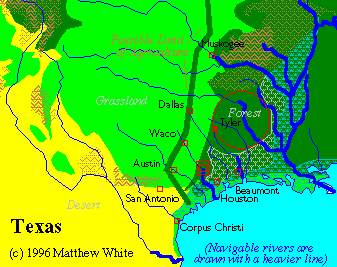
There's a sub-map for the Pacific Northwest, which is titled "Cascadia". The weird thing is, the file name is "pac-northwest", which is what you get from clicking on cities like Seattle and Portland. But it also has the flag for the District of Columbia inside that so...while it doesn't raise an insane amount of questions, I am left to wonder about the formatting, if not the content. I do wonder what the Columbia page is, though, since it seems to be this country without any major cities in it. Also, more of Medieval Texas is explored. White himself has an image for Texas, although I'm unsure what page it would have appeared on. Perhaps the tribal page? In any case, the most eastern of Texas is fused with some of Louisiana and Arkansas to form "Red River Territory", the most western absorbed by new Mexico, and the bulk of it under a tribe named the Andersons, who have nevertheless kept Houston up and running. Generally makes sense for the competing (Dixie, Latino and Plains) cultures,, although I am curious to know how "Texas" plays into any sense of nationalism for the region.
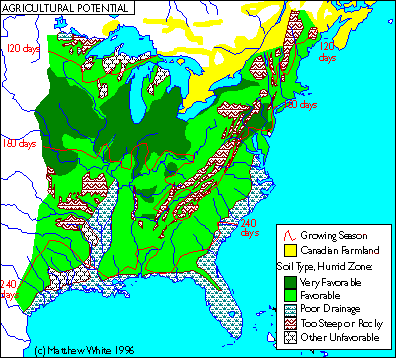
Perhaps the one thing I was way off the mark on about was the Yankees. I think I'm generally correct about what culture is like in the Northeast, but apparently I was incorrect in interpreting the Yankee symbol as a boat (it's a plow), and extrapolating it to be mostly a maritime culture. This probably remains true for the three Northeast nations, it's just that I'm incorrect in assuming the Northeast is distilled "Yankee" culture. Or maybe not, as the icon isn't any further west than Pennsylvania. I do think Ohio and it's four District HQs does give it something common in the Northeast, but it's still arguable as a "Yankee nation". I'm assuming this map would go to that particular page. Unfortunately, there are no other pictures for that "How they would" dress, no for the "Irrigation" (Desert-Dwellers) page, which is unfortunate. I suppose very little I've said on the subject has proven to be wrong, but I do have doubts.
I've mentioned very little of it on this blog, but White does have a page for the Jackelope, which led me to believe other American folklore monsters had one, and I was correct. There are images for Bigfoot, Mothman, the Jersey Devil, and Roswell aliens. That covers most of the American folklore monsters (I suppose Wendigos and Men in Black could be mentioned as well), although I have myself wondered about what other folklore would exist in Medieval America. Christmas Elves? Tooth Fairies? Movie monsters? I do think White covered the most he could while 1) Remaining exclusive to America, and 2) In the public domain. My next post is actually going to touch on how popular culture would fit into American folklore. Interestingly, there is also a file image for Elvis, connected to the confederate flag. (Though I would think him attached to a Tennessee flag) I was also thinking about Elvis before I saw that--he's both a entertainment legend and an urban legend, as he's often mentioned in the same publications as Bigfoot and UFOs, so he probably has some folklore status as well.
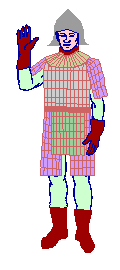
The only figure I did find from White is a Knight, probably for the Lancers page. I...kind of doubt we'd see pastels like that, but I think I see what he's going for here. The armor reminds me a little bit of the Asian grid designs , which combined with some elements we see in European armor, is something pretty unique. Actually, it reminds me of the look the villains from the film version Prince Caspian. I don't know what nation this is from in particular, (Though I imagine it'd be one from the feudal core) and if the knights look different in the desert, in Quebec, if one some of them have more native American motifs, but I have actually been doing some sketches. In any case, it's nice to have a taste of something that obviously plays a big part in the continent.
In general though, this will lead me to go back and clarify questions, and revamp some ideas. At first I was on the mission of suggesting, not telling. Then I got it in my head to just tell, now I may go back and suggest. I suppose I've done as much as I can without actually doing to nations per se. What I'm thinking of doing is creating a wiki for all this. I was hesitant because White hates Wikipedia, and it would feel a little disrespectful, but I think I may have taken this as far as it can go in blog form (at least until I do illustrations), and it's obvious I will have to retouch things over time.
The borders for the East of America, and the West half. Also, this here gives you a good idea on the various borders around the continent. White pointed out that the forest zones could be a disparate patchwork, but I had no idea how much. It seems most balkanized around the Appalachian and Ozark Highlands, though it's also that way in both the Northeast and Northwest. (No surprise there, as they operate as mercantile city-states. I'm most surprised to see New York and parts of Canada have fragmented so. It has caused me to think a lot about Quebec's expansion. Quebec proper is safely tucked away where it has been. But I would think Canada's being broken up might make it subject to conquest. If cowboys can conquer everything in site, I don't know why Quebecois wouldn't. This map displays the language of the region, and while it doesn't confirm anything about Quebec, I do notice New York seems to have a similar gradient as the Ottawa metro-area, so I wouldn't say the theory is shot down. The New York flag has the statue of liberty, which is an American symbol, but it's also a french statue, so...part of me is tempted to abandon the French New York thing, but I don't have anything to truly shout it down yet.

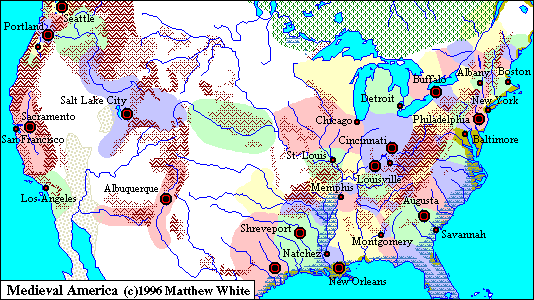
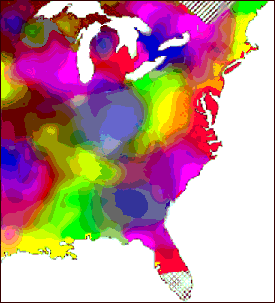

There's a sub-map for the Pacific Northwest, which is titled "Cascadia". The weird thing is, the file name is "pac-northwest", which is what you get from clicking on cities like Seattle and Portland. But it also has the flag for the District of Columbia inside that so...while it doesn't raise an insane amount of questions, I am left to wonder about the formatting, if not the content. I do wonder what the Columbia page is, though, since it seems to be this country without any major cities in it. Also, more of Medieval Texas is explored. White himself has an image for Texas, although I'm unsure what page it would have appeared on. Perhaps the tribal page? In any case, the most eastern of Texas is fused with some of Louisiana and Arkansas to form "Red River Territory", the most western absorbed by new Mexico, and the bulk of it under a tribe named the Andersons, who have nevertheless kept Houston up and running. Generally makes sense for the competing (Dixie, Latino and Plains) cultures,, although I am curious to know how "Texas" plays into any sense of nationalism for the region.

Perhaps the one thing I was way off the mark on about was the Yankees. I think I'm generally correct about what culture is like in the Northeast, but apparently I was incorrect in interpreting the Yankee symbol as a boat (it's a plow), and extrapolating it to be mostly a maritime culture. This probably remains true for the three Northeast nations, it's just that I'm incorrect in assuming the Northeast is distilled "Yankee" culture. Or maybe not, as the icon isn't any further west than Pennsylvania. I do think Ohio and it's four District HQs does give it something common in the Northeast, but it's still arguable as a "Yankee nation". I'm assuming this map would go to that particular page. Unfortunately, there are no other pictures for that "How they would" dress, no for the "Irrigation" (Desert-Dwellers) page, which is unfortunate. I suppose very little I've said on the subject has proven to be wrong, but I do have doubts.
I've mentioned very little of it on this blog, but White does have a page for the Jackelope, which led me to believe other American folklore monsters had one, and I was correct. There are images for Bigfoot, Mothman, the Jersey Devil, and Roswell aliens. That covers most of the American folklore monsters (I suppose Wendigos and Men in Black could be mentioned as well), although I have myself wondered about what other folklore would exist in Medieval America. Christmas Elves? Tooth Fairies? Movie monsters? I do think White covered the most he could while 1) Remaining exclusive to America, and 2) In the public domain. My next post is actually going to touch on how popular culture would fit into American folklore. Interestingly, there is also a file image for Elvis, connected to the confederate flag. (Though I would think him attached to a Tennessee flag) I was also thinking about Elvis before I saw that--he's both a entertainment legend and an urban legend, as he's often mentioned in the same publications as Bigfoot and UFOs, so he probably has some folklore status as well.
The only figure I did find from White is a Knight, probably for the Lancers page. I...kind of doubt we'd see pastels like that, but I think I see what he's going for here. The armor reminds me a little bit of the Asian grid designs , which combined with some elements we see in European armor, is something pretty unique. Actually, it reminds me of the look the villains from the film version Prince Caspian. I don't know what nation this is from in particular, (Though I imagine it'd be one from the feudal core) and if the knights look different in the desert, in Quebec, if one some of them have more native American motifs, but I have actually been doing some sketches. In any case, it's nice to have a taste of something that obviously plays a big part in the continent.
In general though, this will lead me to go back and clarify questions, and revamp some ideas. At first I was on the mission of suggesting, not telling. Then I got it in my head to just tell, now I may go back and suggest. I suppose I've done as much as I can without actually doing to nations per se. What I'm thinking of doing is creating a wiki for all this. I was hesitant because White hates Wikipedia, and it would feel a little disrespectful, but I think I may have taken this as far as it can go in blog form (at least until I do illustrations), and it's obvious I will have to retouch things over time.
Friday, November 6, 2009
New Age
Despite much of the Southwest originally being Catholic in nature, religion in the desert can be a lot like flooding a basin. The isolation means the message gets spread to everybody, and there are not too many outside forces to compete with. That's the nature hydraulic empire--religions can be pretty uniform, easy to enforce, and prone to some very bizarre whims. In the Industrial Age, New Ange movements were informal and de-centralized, and hard to define vagaries. But in the new Middle Ages, most New Age believers were flushed out as heretics, and in the Southwest Hydraulic Emperors tightly guided from a grassroots belief system into a a highly organized and heiarchial one.
In a lot of ways, New Age is like Buddhism. There's a reverence for their Earth, a belief in enlightenment, and a need for purity and meditation. However, in other ways there are complete opposites. Buddhism focuses very much on the earthly surroundings of the natural world, while New Age focuses on the beyond. The clear skies and the somewhat barren landscape have led them to study stars and see them as sacred.
Astrology plays a large role in the religion. The Zodiac is the frame of reference for religious doctrines and practices. Priests are required to study the movement of the stars and planets. Both governor and peasant alike take their horoscopes very serious. Signs will often play a role in the name a child is given, and the career they are apprenticed towards. It's also a large part of matchmaking, as marriages between incompatible signs are a taboo. Many a tragic tale is told over "star-crossed lovers".
Priests have a very active role in the lives of the southwest populace and royal courts. Besides astrology, they are also trained to develop therapeutic teas and massage techniques. They are often charged with healing, which may sometimes rely on herbs, but just as often disease is countered with crystal baths and chanting. In funeral rites, they may place emeralds with departed.
There is a specific priest caste which religious higher ups are born to, but ever now and then they will learn of a child with strange or autistic behavior, who they will induct into their ranks. They are called Indigos, and their jobs usually involve calculating or deciphering mathematical equations, which the priests will interpret the meaning of.
In a lot of ways, New Age is like Buddhism. There's a reverence for their Earth, a belief in enlightenment, and a need for purity and meditation. However, in other ways there are complete opposites. Buddhism focuses very much on the earthly surroundings of the natural world, while New Age focuses on the beyond. The clear skies and the somewhat barren landscape have led them to study stars and see them as sacred.
Astrology plays a large role in the religion. The Zodiac is the frame of reference for religious doctrines and practices. Priests are required to study the movement of the stars and planets. Both governor and peasant alike take their horoscopes very serious. Signs will often play a role in the name a child is given, and the career they are apprenticed towards. It's also a large part of matchmaking, as marriages between incompatible signs are a taboo. Many a tragic tale is told over "star-crossed lovers".
Priests have a very active role in the lives of the southwest populace and royal courts. Besides astrology, they are also trained to develop therapeutic teas and massage techniques. They are often charged with healing, which may sometimes rely on herbs, but just as often disease is countered with crystal baths and chanting. In funeral rites, they may place emeralds with departed.
There is a specific priest caste which religious higher ups are born to, but ever now and then they will learn of a child with strange or autistic behavior, who they will induct into their ranks. They are called Indigos, and their jobs usually involve calculating or deciphering mathematical equations, which the priests will interpret the meaning of.
Thursday, November 5, 2009
Scientology
In the Industrial Era, much of the West Coast was secular in nature, with basic Christian tenets merely informing its lifestyle. From Las Vegas to Los Angeles to San Francisco, much of the regions west of the Rockies had, at best, a tenuous relationship with the country's religious leaders. However, once society slid back into medieval era, people were going to slide back into religion no matter what. All it needed was something to fill the vacuum.
The Church of Scientology started out as a fringe cult fronted by eccentric celebrities. This tended to be a boon when society started devolving. Even though performers have little practical use in a back-to-basic civilization, wealthy performers may have a little more clout. Estates of the rich and famous would be lent out to the peons, and celebrities could maybe amass a few loyal bodyguards. Some may have even had enough foresight to stock up on goods and hide in a personal complex until the worst was over, and they could come out to pick up the pieces.
This is where the Church of Scientology stepped in. Often criticized for its bizarre ideas and scare tactics, the fact was, nothing really stood out as insane as somebody had some kind of out-there religious epiphany on every corner. It's just that the CoS was well-equipped with charismatic and already well-known preachers. Many of the huddled masses even found comfort in familiar faces from better times, and a tightly rigid structure. Sure hierarchy was brutal and treated them as little more than slaves, but this was par for the course everywhere in the desert, so it might as well be them. Laws against detergents and psychiatry mean rather little when they're not around anyway. Criticisms on how credible the back story is also bounce of a populace that is mostly illiterate and superstitious anyways.
While things like Xenu, Thetans and Auditing still exist in the Church, a large amount of the canon has slowly been permuted with what's known as "Hollywood folklore". It's filled with heroes like Indiana Jones, goddesses like Marilyn, wizards like Vader, monsters like Kong, and locales like Casablanca. The Mann's theater is a place to canonize their heroes and saints, and rulers are appointed with a gold statue of a man at their coronation. It's said that upon death, the President of the Church will join his ancestors and become a star in the sky. These figures of Californian mythology appear in a lot of art and sculptures, as the CoS is the largest employer of artisans and masons, and often wish to make their places of worship ornate and easy for the peasants to understand. Californian art and architecture also has a recurring motif of rings and arches.
Interestingly, many of the Holidays of the Church match the Non-Denominational ones. Festivals are held around the same times Thanksgiving, Christmas, and the Fourth of July are in the East, however the celebrations are strictly held to the weekend. There is also a major Memorial Day, to commemorate those destroyed by Xenu. (Because there are not a lot severe winters in California, spring festivals do not feature in Scientology very much. More often Scientologists use spring as a time to discard or use up lesser possessions) These festivals are known for producing large theatrical productions which tell stories of many great heroes and events in the culture. November tends to focus on stories for children, December pageants tell their stories with song, and July presents stories of the most heroic and bombastic feats.
The Church of Scientology started out as a fringe cult fronted by eccentric celebrities. This tended to be a boon when society started devolving. Even though performers have little practical use in a back-to-basic civilization, wealthy performers may have a little more clout. Estates of the rich and famous would be lent out to the peons, and celebrities could maybe amass a few loyal bodyguards. Some may have even had enough foresight to stock up on goods and hide in a personal complex until the worst was over, and they could come out to pick up the pieces.
This is where the Church of Scientology stepped in. Often criticized for its bizarre ideas and scare tactics, the fact was, nothing really stood out as insane as somebody had some kind of out-there religious epiphany on every corner. It's just that the CoS was well-equipped with charismatic and already well-known preachers. Many of the huddled masses even found comfort in familiar faces from better times, and a tightly rigid structure. Sure hierarchy was brutal and treated them as little more than slaves, but this was par for the course everywhere in the desert, so it might as well be them. Laws against detergents and psychiatry mean rather little when they're not around anyway. Criticisms on how credible the back story is also bounce of a populace that is mostly illiterate and superstitious anyways.
While things like Xenu, Thetans and Auditing still exist in the Church, a large amount of the canon has slowly been permuted with what's known as "Hollywood folklore". It's filled with heroes like Indiana Jones, goddesses like Marilyn, wizards like Vader, monsters like Kong, and locales like Casablanca. The Mann's theater is a place to canonize their heroes and saints, and rulers are appointed with a gold statue of a man at their coronation. It's said that upon death, the President of the Church will join his ancestors and become a star in the sky. These figures of Californian mythology appear in a lot of art and sculptures, as the CoS is the largest employer of artisans and masons, and often wish to make their places of worship ornate and easy for the peasants to understand. Californian art and architecture also has a recurring motif of rings and arches.
Interestingly, many of the Holidays of the Church match the Non-Denominational ones. Festivals are held around the same times Thanksgiving, Christmas, and the Fourth of July are in the East, however the celebrations are strictly held to the weekend. There is also a major Memorial Day, to commemorate those destroyed by Xenu. (Because there are not a lot severe winters in California, spring festivals do not feature in Scientology very much. More often Scientologists use spring as a time to discard or use up lesser possessions) These festivals are known for producing large theatrical productions which tell stories of many great heroes and events in the culture. November tends to focus on stories for children, December pageants tell their stories with song, and July presents stories of the most heroic and bombastic feats.
Wednesday, November 4, 2009
Voodoo
The Northeast of America has always had a somewhat adversarial relationship with the rest of the country. Further west, the Non-Denominational Church has been essentially rejected. In the south, the Church districts are farther and farther apart, and nations pay less and less attention to what the Supreme Court has to say. Religion has been relatively unorganized and independent, and typical evangelist congregations have been supplanted by Voodoo along the Gulf Coast.
There are a couple of other reasons for the spread of Voodoo. Besides the growing infusion of Caribbean culture, the more African descended population may have felt more of a kinship than religion dominated by the ethnically different Yankees. Its spread also has a lot to due with the presence of Secretarial States. Women are given a prominent role in the bureaucracy and stability of the deep south, because the men are off fighting, fishing or doing merchant work. With males usually away, women were also left to their own devices in the field of worship. As Louisiana Voodoo is a faith that gives women a prominent role, it seemed like a pretty natural fit. Spiritual leaders called Voodoo Queens can provide the spiritual needs of the community. It's also a reflection of the Non-Denom church performing the bureaucratic services of its territory. Since the bureaucracies of the Gulf Coast are made up of women, women might as well be helping out with the religious duties. Schools are taught in Creole, medicine is administered by priestesses, and whatever passes for Voodoo organization keeps track of will and deeds. Voodoo Queens may also play a part in the royal family's linage.
Because property is passed from father-in-law to son-in-law, there's less of a pressure to produce male heirs. If the queen gives birth to a boy, that's great, and makes things a little more straightforward. But if it's a girl, she's simply trained to be a High Queen, and they look for a worthy bridegroom among the noble families. Heritage is matrilineal anyways, and this allows the father's direct line to at least play some part in the authority of the state. This of course, has led to a lot of politicking and abuse in its own right, but the point is, nothing short of infertility will cause a succession crisis.
By the way, the presence of Voodoo Queens in the royal family make these states, in theory, theocracies, but the very informal nature prevents secular and religious conflicts of interest. Voodoo leaders are more or less charged with organizing and performing rites, or divinations. There isn't a particular lot of dogma to create schisms with anyways. But that's not to say rulers haven't used to to their advantage.
In some ways,Voodoo does resemble Catholicism, with the importance of Christ and much of the pageantry. However, the Voodoo Church is in many ways quite divergent with the Non-Denominational Church, and only moreso as the two faiths have canonized different saints over the years. Marie Laveau is there most important figure. Voodoo also uses widely different symbols (aside from the cross), with imagery like snakes, skulls and card motifs. Combined with the language, rites, and prominence of women, Non-Denoms view Voodoo practitioners as little more than pagans, and nations like Mississippi and Red River have found themselves embroiled in furious religious wars for Louisiana.
There are a couple of other reasons for the spread of Voodoo. Besides the growing infusion of Caribbean culture, the more African descended population may have felt more of a kinship than religion dominated by the ethnically different Yankees. Its spread also has a lot to due with the presence of Secretarial States. Women are given a prominent role in the bureaucracy and stability of the deep south, because the men are off fighting, fishing or doing merchant work. With males usually away, women were also left to their own devices in the field of worship. As Louisiana Voodoo is a faith that gives women a prominent role, it seemed like a pretty natural fit. Spiritual leaders called Voodoo Queens can provide the spiritual needs of the community. It's also a reflection of the Non-Denom church performing the bureaucratic services of its territory. Since the bureaucracies of the Gulf Coast are made up of women, women might as well be helping out with the religious duties. Schools are taught in Creole, medicine is administered by priestesses, and whatever passes for Voodoo organization keeps track of will and deeds. Voodoo Queens may also play a part in the royal family's linage.
Because property is passed from father-in-law to son-in-law, there's less of a pressure to produce male heirs. If the queen gives birth to a boy, that's great, and makes things a little more straightforward. But if it's a girl, she's simply trained to be a High Queen, and they look for a worthy bridegroom among the noble families. Heritage is matrilineal anyways, and this allows the father's direct line to at least play some part in the authority of the state. This of course, has led to a lot of politicking and abuse in its own right, but the point is, nothing short of infertility will cause a succession crisis.
By the way, the presence of Voodoo Queens in the royal family make these states, in theory, theocracies, but the very informal nature prevents secular and religious conflicts of interest. Voodoo leaders are more or less charged with organizing and performing rites, or divinations. There isn't a particular lot of dogma to create schisms with anyways. But that's not to say rulers haven't used to to their advantage.
In some ways,Voodoo does resemble Catholicism, with the importance of Christ and much of the pageantry. However, the Voodoo Church is in many ways quite divergent with the Non-Denominational Church, and only moreso as the two faiths have canonized different saints over the years. Marie Laveau is there most important figure. Voodoo also uses widely different symbols (aside from the cross), with imagery like snakes, skulls and card motifs. Combined with the language, rites, and prominence of women, Non-Denoms view Voodoo practitioners as little more than pagans, and nations like Mississippi and Red River have found themselves embroiled in furious religious wars for Louisiana.
Subscribe to:
Posts (Atom)