Friday, May 28, 2010

Louisiana

As the United States dominates the Eastern Seaboard, Louisiana is primarily the Maritime power of the Gulf Coast. It is a largely a collection of Creole merchants who set up ports on the edges of the southern bayous. The cities and towns are essentially marinas and flea markets, and largely informal. Not to the nomadic extent of the western herdsmen, but it's common to see open-air markets and ships rendered as sumptuously as houses. The main hub is the city of New Orleans, a sprawling city of canals that is the home to seats of government, important religeous figures, and a vast necropolis to bury the dead.

The city of New Orleans is one of the most important places in America, as it not only serves as the gateway between North and South America, but the Mississippi River is the primary access from inland America to the warmer seas. There used to be a few wars fought to control the city, especially to wrest it from the Voodoo practitioners who ran it, but the Midwest demanded that a peace be kept on the city, because sieges on the river and the city would mean a lapse in trade which could make the upper classes feel like petty country barons at best, and decimate the populations at worst.

Louisiana is also the primary trading partner with Texas. Texas has the port of Houston where it can trade things like leather-work, as they have very little interest in engaging with sea travel. Louisiana also makes a good intermediary buyer. The ruling Anderson family is not on good terms with its eastern neighbor, the Red River Territory. Although Texans and Louisianans are of mutually different faiths, the latter don't much care about that sort of thing, and don't really have anything the cowboys wants. Therefore, the mariners distribute the Texans' goods with the non-denominational world, and in turn bring sundry items to the Texans. All for a tidy profit, of course.

Thursday, May 27, 2010

New England

New England is a fractured collection of City-States in the most Northeast of America. Denizens of New England consider themselves the spiritual and intellectual heart of the continent. Six Non-Denominal supervisors have jurisdiction here, making New Englanders some of the most prominent and heard voices in church matters. The new Englanders will also hold conferences the supervisors of the Maritimes. The denizens also tend to be a lot more learned, due to the high proportion of Church schools to population. With the shorter growing season, children have more time to occupy themselves, and schooling at the churches is a good way to keep busy. New England's universities are attended by nobles from all over the east, and such universities are centers of learning and culture.

The universities and church districts may sometimes serve as municipal hubs. Warlords have taken very little interest in the areas, which leaves the communities to run themselves. Most of the towns and villages in New England operate rather autonomously. Communities administer their laws through the local Town Halls, with councils generally voted upon by the citizens. The most direct democracy in Medieval America, although in practice guild leaders easily run these councils. The Non-Dominational district supervisors will often run the towns to extent. People are assigned to secular duties, but the Churchmen's counsel carries a special weight in legal matters.

Massachusetts

However Massachusetts, the largest and most populous of the New England states, runs a bit differently. They have a General Court and Towns Halls, but they operate as an oligarchic republic, much like the United States. Providence and Boston are ideal trading ports, and thus made way for a wealthy merchant class. With this wealth and array of ships, Massachusetts began to operate like a decadent bully, and acted like it ran the entirety of New England, and even the Maritimes. Because of this, the smaller New England states allowed the US to establish bases along their coast. It has since been a struggle between Massachusetts and US, with a tug of war on claims to Boston and Providence. Right now, Massachusetts' hope is getting the rest of New England behind them after the US has essentially dominated New England's coast.


  • System of Government: Republic
  • Head of State:
    • Massachusetts: Governor, elected in terms by houses of the General Court
  • Population: 2 Million
    • Massachusetts: 600,000

Friday, May 21, 2010

Cities

So how big are the cities in White's World? What are the most prominent?

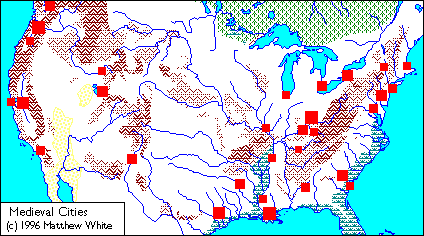
New York and Los Angeles are the primary cities of the current U.S., and the second largest are Chicago and Houston. (Occupying the "other" two coasts) All four cities seem to see a downgrade in Medeival America. This is largely because these cities have benefitted from interconinetal trade, whereas the oceans feel a lot more vaster in the Medeival world, and trade has to be conducted closer to home. America, in particular, can't be a clone of Europe most of the time because there's simply no great counterparts to the Meditarrnean. All inland seas are in places that are too cold too dry, or too swampy. Therefore, the biggest cities are located on rivers.

So what are the absolute most major cities? The most populated? Maps indicate they would be Cincinatti, Portland and New Orleans. The next tier appears to be Buffalo, Sacremento, Philadelphia, and possibly Houston and Augusta. Interestingly, the latter two cities are not considred trading hubs, while the smaller Salt Lake City is. New Orleans itself may be the most populated city in America--it's certainly the gateway between the Mississippi River and the open ocean.

I'm also curious as to what District Capitals and "Major Fortresses" look like. These are towns which may or may not have large populations, but it seems they have a degree of importance despite size or trade convenience. In reasonable-sized cities like Nashville and Boston, there's probably a good deal of prestige combined with political power. Towns like Lexington and Dover may be glorified abbeys.

We may see less "special" cities out in the west. The "special" communities are very likely the nomadic villages, or cities with the strange monuments that are hallmarks of the Hydraulic Empires. However, there are settled communities in Arizona, but no named cities. I would frankly like to know what they look like.

Thursday, May 20, 2010

American Bestiary


As I mentioned before, it looked like one of things White wanted to do was a catalogue of monsters unique to Americana. He seemed to mostly draw from folklore and cryptozoology. The task can be pretty challenging for the same reason it had to be done--most United States culture post-dates a common belief in the supernatural. I theorize that, as a largely European-based culture, there's probably a lot of European creatures like dragons, elves and goblins. However, the point here is to explore the quintessentially American ones.

On the original map, White only has five; The Mothman, Bigfoot, the Jersey Devil, some kind of representation of Aliens, and the Jackelope. The Jackelope has already been featured on the Herdsmen page. Bigfoot would be on the Pacific Northwest one, (Maybe the district of Columbia in particular) the Jersey Devil in New Jersey (natch--maybe the motivator in making it its own nation), the little Roswell fellow would probably be on the New Mexico page. The Mothman could be part of the Piedmont page, but it's not out of the question for it to be in Ohio. Somewhere in the Appalachian range. Maybe even the "East Heresy" or "Tennessy" page.

For me, five was too few though, and I added four more of the Jack O'Lanterns. I could have added many more, but that might have crowded up the feudal core a little too much. I wanted to spread it out a bit. But two monsters that have existed in folklore are the Squonk and the Goatman. The Squonk is said be an ugly, warty creature that sheds tears when captured, dissolving itself in self-pity and shame. The Goatman is an Satyr-like creature that attacks dogs and parked cars. Similar creatures are also said to inhabit Colorado and Kentucky. However, I wouldn't know where to put it. Not only does the Mid-Atlantic have its own beast, but Maryland, as an entity, no longer exist. Plus, less cars for it to attack.

Near the great lakes, one could talk about the hodag, another denizen of lumberjack myth, like the jackelope. A strange cross between a dragon and a rhino, they are said to inhabit Wisconsin and Minnesota. Legend has it, their legs cannot bend, so they sleep leaning against trees. Chopping down its sleeping tree will make it an easy capture.

Upper Quebec would be a great place to talk about the Wendigo, the most well-known of Native American monsters. Obviously, not a lot of American Indian myths would be subject to this kind of thing, (Their folklore is heavily guarded and taken very seriously) but the Wendigo has nontheless been a very frequent opponent in popular culture, throughout films, novels and comic books. It would also add a bit of spice to the Quebec page.

The next two, I'm not dead-set certain on. I have an icon placed on the gulf coast, because the gulf has always been treated as a ripe place setting for the supernatural. New Orealns itself is too "tame" for a mythical beast, but something may be out there in the bayous. Perhaps the best choice would be the "Loupgarou"--Louisiana's answer to the werewolf. Florida also has reports of a bigfoot type creature, the "Skunk Ape". Alabama is also home to the "Wampus Cat", a felinoid shape-shifter. In any case, these, or a combination thereof, could be great monsters.

And finally I have an icon for Death Valley. As you can see, there should be a pattern of "Here be monsters" in rather remote locales. The first one that comes to mind is the Chupacabra, the most famous modern monster in Latin America. However, between the Jackelope's page, and the possibility for the "Roswell" monster, it might be a little redundant. However, upper Mexico has many possibilities, like the weeping La Llarona, and the fiery El Zobro.

Tuesday, March 9, 2010

Forest Zones Around the World

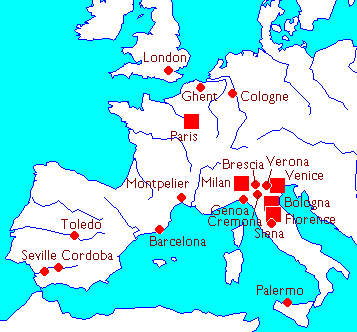
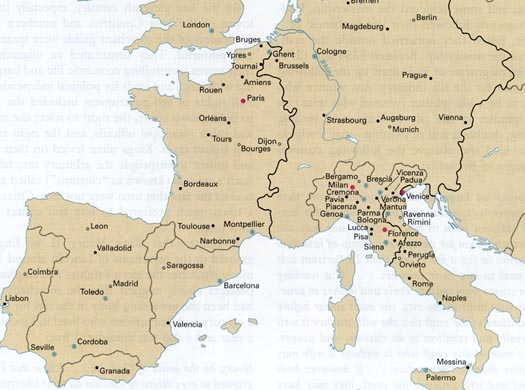
Stored in White's archives is a map of Europe. Wondering what the point of it was, I soon discovered this page here, which seems to be a definitive map highlighting the most major medieval European cities. (I'm guessing in excess of 50,000) Noticeably, the map cuts out places like Scandinavia and most of the British Isles, and areas where there were no major cities until we get into Byzantine territory.That is, it seems a large part of what's covered is land once occupied by the Roman Empire, and over which the Catholic Church had a stronghold. (With the fluctuating example of Iberia) It's a pretty good marking line, but what intrigues me is White has a map right here, which is all the largest (50k) cities in the former United States. More interestingly, Roman-touched Europe is comparable in size to to Non-Denom America. with the same number of these major cities.

The point is, West Europe and East America are almost perfect analogs for one another. Similar climate, population sizes, and the general feudal remains of an expnansive empire, only united by the big religious entity . A few differences pop up here and there, though. Most cities crowd around Italy and Iberia, while America is a little more spread out. Medieival Europe, as a whole is a very peninsular continent, who's steepest mountain ranges cut through the middle, so we see cities hugging the coast, Toledo and Paris being the most inland cities. America's geography lends itself to different phenomena. On the Atlantic, there's really nowhere to go laterally, and while the Gulf of Mexico does make a good transport, the shores are swampy and less ideal for ports than the Mediterranean. The main water routes are the Missisipi and Ohio rivers. The Great Lakes also act as a de facto sea, , but the region is also prone to harsh winters. Ultimately, the different regions of America have their own pros and cons, no one spot dominates.

As for other forest zones comparable to medieval Europe and America? Well, White has mentioned India as a region where feudal states tend to pop up. It's also a very easy-to-distinguish section due to its peninsular shape, and you can't throw a rock in the ancient world without hitting one of its major cities. You could say it's the third of these feudal areas. East Asia is hard to distinguishdue to China's incredible size and population--it's hard to know what to separate. If I had to establish a core point, it would be along the Yellow River, where historically most Chinese cities sprouted on--with the area around the Korean Peninsula being the upper limit. Like England, Japan would interact with this core, but only have a city inside it. The thin and rugged terrain of island nations limit their power in medieval times.

South America, particularly Brazil, would serve as the fourth great feudal culture. It's both easy and hard to imagine. It's structured a lot like the US; a heavily populated nation with a long racial gradient and a huge backyard; Its the jus the US has a west coast and Brazil doesn't. As I've mentioned before, the tropical climate brings India to mind. It can be somewhat simple to divide. The Southeast and Northeast are the most populated, so one could cut up a region there. On the other hand, the more temeperate and fertile south may yield higher populations, and absorb parts of Argentina and Paraguay. Meanwhile, Northern Bahia could serve as a buffer, where Northeastern Brazil starts to observe more Caribbean customs. The Caribbean is its own cultural zone really, but keep in mind we're working with areas of a certain amount of square miles and potential for twenty cities. (Western America, Central America, North Africa and the Northern Middle East are all examples of very populated and important cities that house impressive populations, but the arid conditions prevent too many from popping up.)

The last sizable forest zone in in Eastern/Europe, central Asia. The interesting thing is, this might be the one Old World location that wouldn't be a rerun of past eras. It's always been in flux, with conquerors as diverse as Byzantines, Ottomans and Mongols. And then there was Russia, which became a major power and a more solidified culture well after the middle ages, where in the 20th Century it was a major power. Would the steppes be conquered by nomads? Would someone make use of the black sea and the silk road? What would a post-communist medieval world look like? One could have fun there.

Sunday, March 7, 2010

Types of People

Just for fun, I decided to keep a list of all the classes and ethnic groups that make up Medieival America. The one sin italics are my own personal spin.

Cowboys: Barbarians of the Great Plains that raise cattle for sustinence, horses for war.
Warlords: Master of feudal states, located chiefly in forest zones. Career warriors.
Churchmen: Members of the Non-Denominational Church. Beauracrats and civil servants.
Secretaries: Fill similar roles of Churchmen, only are female nobles found in the Caribbean.
Nomads: Technically, cowboys are nomads, but some million shepherds roam the desert.
Mariners: Sailors who's tarde and fighting piece together empires on the coast.
Governors: Rulers of the desert. Exerts spirtiual and secular rule.
Merchants: Traders who, on the coastal inlets, run Republican city-states.
Buddhists/Monks: Wanderers who preach environmentalism in the Northwest.
Mormons/Templars: Inhabitants of Deseret.
Scienoss: Californians who revere old Hollywood stories.
Shamans: Healers in the desert.
Canucks: Inhabitants of former Canada. Ride dogsleds and hunt for food.

Saturday, March 6, 2010

Updates

Okay, so I think I've more or less done the articles for Government, Military, Lifestyle and Religion. I haven't really done, and probably will not do much, with the actual nation names, since 1) it's more about specific history than cultural overviews, and borders are essentially ever shifting and not necessarily beholden to nature, and 2) This is where I feel I would really be infringing on White's writing, as opposed to extrapolating. The only nation I really got any huge ideas for was New Jersey, which was inspired by the Mafia because they took to feudalism like ducks to water. Other nations I might do articles for might be New England, Quebec, Louisiana and New Mexico, because I think they have more going on culturally, as opposed to Piedmont or Ohio, which are more political.

Perhaps the "Here Be Monsters" articles, but even then, that's something that feels like somethig that horns in on White's writing, as opposed to answering questions he left asked.

In the meantime, I've been going back and refinign articles. Some changes;

Yankees: Because the icon was a plow, not a ship, I played down the maritime culture. It's still there, but I focused more on how the more solid land and decrease in infection allows a more structured population. I also took out the part about clothes, because it's redundant, we know what it would look like.

Republics: Renovated the whole building. Focused on Merchants as a class, and why some regions are feudal and some are republics. (And it comes down to compromise and having other people to answer to)

Feudalism/Knights: Focused more on the Warlords as a class. Still trying to figure out what would make it different in America. May explore Indian pyramaid mounds.

New Age: Added some stuff about healing crystals and other medicinal functions of the religion.

Scientology: More articulately explained why the Scrappy of religions took over California.

Voodoo: Decentralized the religion a little bit, since I had realized I turned Voodoo states into theocracies. And I get the sense the Caribbean regions are probably more free-wheeling than that.

Irrigation: Emphasized the importance of rivers. Pointed out how denizens may look like Southrons or Herdsmen, with their own cultural flavoring.

Cascadians: Pared down the article a little bit. I still fear the tree-houses may be ridiculous, although it does solve the rain problem. But in general, I came to the conclusion that the Buddhist page already explained what their lifestyle is like, so it may be a little redundant. I might fill in blanks by creating a separate "Pacific Northwest" article White was going to do, and try and make it a granola version of the United States of America page.