
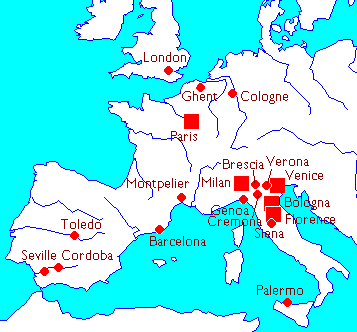
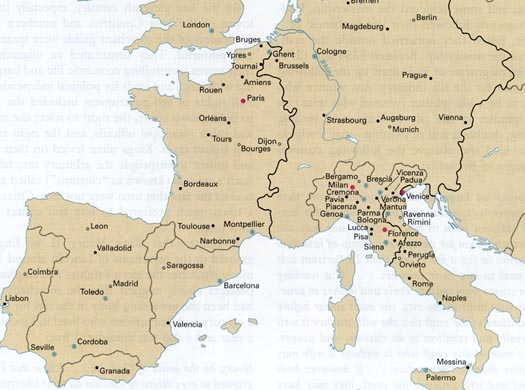
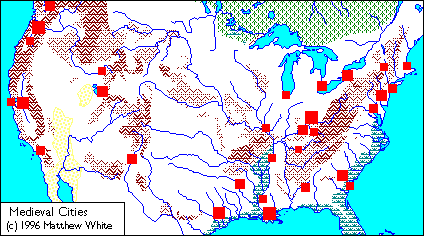
Stored in White's archives is a map of Europe. Wondering what the point of it was, I soon discovered this page here, which seems to be a definitive map highlighting the most major medieval European cities. (I'm guessing in excess of 50,000) Noticeably, the map cuts out places like Scandinavia and most of the British Isles, and areas where there were no major cities until we get into Byzantine territory.That is, it seems a large part of what's covered is land once occupied by the Roman Empire, and over which the Catholic Church had a stronghold. (With the fluctuating example of Iberia) It's a pretty good marking line, but what intrigues me is White has a map right here, which is all the largest (50k) cities in the former United States. More interestingly, Roman-touched Europe is comparable in size to to Non-Denom America. with the same number of these major cities.
The point is, West Europe and East America are almost perfect analogs for one another. Similar climate, population sizes, and the general feudal remains of an expnansive empire, only united by the big religious entity . A few differences pop up here and there, though. Most cities crowd around Italy and Iberia, while America is a little more spread out. Medieival Europe, as a whole is a very peninsular continent, who's steepest mountain ranges cut through the middle, so we see cities hugging the coast, Toledo and Paris being the most inland cities. America's geography lends itself to different phenomena. On the Atlantic, there's really nowhere to go laterally, and while the Gulf of Mexico does make a good transport, the shores are swampy and less ideal for ports than the Mediterranean. The main water routes are the Missisipi and Ohio rivers. The Great Lakes also act as a de facto sea, , but the region is also prone to harsh winters. Ultimately, the different regions of America have their own pros and cons, no one spot dominates.
As for other forest zones comparable to medieval Europe and America? Well, White has mentioned India as a region where feudal states tend to pop up. It's also a very easy-to-distinguish section due to its peninsular shape, and you can't throw a rock in the ancient world without hitting one of its major cities. You could say it's the third of these feudal areas. East Asia is hard to distinguishdue to China's incredible size and population--it's hard to know what to separate. If I had to establish a core point, it would be along the Yellow River, where historically most Chinese cities sprouted on--with the area around the Korean Peninsula being the upper limit. Like England, Japan would interact with this core, but only have a city inside it. The thin and rugged terrain of island nations limit their power in medieval times.
South America, particularly Brazil, would serve as the fourth great feudal culture. It's both easy and hard to imagine. It's structured a lot like the US; a heavily populated nation with a long racial gradient and a huge backyard; Its the jus the US has a west coast and Brazil doesn't. As I've mentioned before, the tropical climate brings India to mind. It can be somewhat simple to divide. The Southeast and Northeast are the most populated, so one could cut up a region there. On the other hand, the more temeperate and fertile south may yield higher populations, and absorb parts of Argentina and Paraguay. Meanwhile, Northern Bahia could serve as a buffer, where Northeastern Brazil starts to observe more Caribbean customs. The Caribbean is its own cultural zone really, but keep in mind we're working with areas of a certain amount of square miles and potential for twenty cities. (Western America, Central America, North Africa and the Northern Middle East are all examples of very populated and important cities that house impressive populations, but the arid conditions prevent too many from popping up.)
The last sizable forest zone in in Eastern/Europe, central Asia. The interesting thing is, this might be the one Old World location that wouldn't be a rerun of past eras. It's always been in flux, with conquerors as diverse as Byzantines, Ottomans and Mongols. And then there was Russia, which became a major power and a more solidified culture well after the middle ages, where in the 20th Century it was a major power. Would the steppes be conquered by nomads? Would someone make use of the black sea and the silk road? What would a post-communist medieval world look like? One could have fun there.
Tuesday, March 9, 2010

Sunday, March 7, 2010
Types of People
Just for fun, I decided to keep a list of all the classes and ethnic groups that make up Medieival America. The one sin italics are my own personal spin.
Cowboys: Barbarians of the Great Plains that raise cattle for sustinence, horses for war.
Warlords: Master of feudal states, located chiefly in forest zones. Career warriors.
Churchmen: Members of the Non-Denominational Church. Beauracrats and civil servants.
Secretaries: Fill similar roles of Churchmen, only are female nobles found in the Caribbean.
Nomads: Technically, cowboys are nomads, but some million shepherds roam the desert.
Mariners: Sailors who's tarde and fighting piece together empires on the coast.
Governors: Rulers of the desert. Exerts spirtiual and secular rule.
Merchants: Traders who, on the coastal inlets, run Republican city-states.
Buddhists/Monks: Wanderers who preach environmentalism in the Northwest.
Mormons/Templars: Inhabitants of Deseret.
Scienoss: Californians who revere old Hollywood stories.
Shamans: Healers in the desert.
Canucks: Inhabitants of former Canada. Ride dogsleds and hunt for food.
Cowboys: Barbarians of the Great Plains that raise cattle for sustinence, horses for war.
Warlords: Master of feudal states, located chiefly in forest zones. Career warriors.
Churchmen: Members of the Non-Denominational Church. Beauracrats and civil servants.
Secretaries: Fill similar roles of Churchmen, only are female nobles found in the Caribbean.
Nomads: Technically, cowboys are nomads, but some million shepherds roam the desert.
Mariners: Sailors who's tarde and fighting piece together empires on the coast.
Governors: Rulers of the desert. Exerts spirtiual and secular rule.
Merchants: Traders who, on the coastal inlets, run Republican city-states.
Buddhists/Monks: Wanderers who preach environmentalism in the Northwest.
Mormons/Templars: Inhabitants of Deseret.
Scienoss: Californians who revere old Hollywood stories.
Shamans: Healers in the desert.
Canucks: Inhabitants of former Canada. Ride dogsleds and hunt for food.
Saturday, March 6, 2010
Updates
Okay, so I think I've more or less done the articles for Government, Military, Lifestyle and Religion. I haven't really done, and probably will not do much, with the actual nation names, since 1) it's more about specific history than cultural overviews, and borders are essentially ever shifting and not necessarily beholden to nature, and 2) This is where I feel I would really be infringing on White's writing, as opposed to extrapolating. The only nation I really got any huge ideas for was New Jersey, which was inspired by the Mafia because they took to feudalism like ducks to water. Other nations I might do articles for might be New England, Quebec, Louisiana and New Mexico, because I think they have more going on culturally, as opposed to Piedmont or Ohio, which are more political.
Perhaps the "Here Be Monsters" articles, but even then, that's something that feels like somethig that horns in on White's writing, as opposed to answering questions he left asked.
In the meantime, I've been going back and refinign articles. Some changes;
Yankees: Because the icon was a plow, not a ship, I played down the maritime culture. It's still there, but I focused more on how the more solid land and decrease in infection allows a more structured population. I also took out the part about clothes, because it's redundant, we know what it would look like.
Republics: Renovated the whole building. Focused on Merchants as a class, and why some regions are feudal and some are republics. (And it comes down to compromise and having other people to answer to)
Feudalism/Knights: Focused more on the Warlords as a class. Still trying to figure out what would make it different in America. May explore Indian pyramaid mounds.
New Age: Added some stuff about healing crystals and other medicinal functions of the religion.
Scientology: More articulately explained why the Scrappy of religions took over California.
Voodoo: Decentralized the religion a little bit, since I had realized I turned Voodoo states into theocracies. And I get the sense the Caribbean regions are probably more free-wheeling than that.
Irrigation: Emphasized the importance of rivers. Pointed out how denizens may look like Southrons or Herdsmen, with their own cultural flavoring.
Cascadians: Pared down the article a little bit. I still fear the tree-houses may be ridiculous, although it does solve the rain problem. But in general, I came to the conclusion that the Buddhist page already explained what their lifestyle is like, so it may be a little redundant. I might fill in blanks by creating a separate "Pacific Northwest" article White was going to do, and try and make it a granola version of the United States of America page.
Perhaps the "Here Be Monsters" articles, but even then, that's something that feels like somethig that horns in on White's writing, as opposed to answering questions he left asked.
In the meantime, I've been going back and refinign articles. Some changes;
Yankees: Because the icon was a plow, not a ship, I played down the maritime culture. It's still there, but I focused more on how the more solid land and decrease in infection allows a more structured population. I also took out the part about clothes, because it's redundant, we know what it would look like.
Republics: Renovated the whole building. Focused on Merchants as a class, and why some regions are feudal and some are republics. (And it comes down to compromise and having other people to answer to)
Feudalism/Knights: Focused more on the Warlords as a class. Still trying to figure out what would make it different in America. May explore Indian pyramaid mounds.
New Age: Added some stuff about healing crystals and other medicinal functions of the religion.
Scientology: More articulately explained why the Scrappy of religions took over California.
Voodoo: Decentralized the religion a little bit, since I had realized I turned Voodoo states into theocracies. And I get the sense the Caribbean regions are probably more free-wheeling than that.
Irrigation: Emphasized the importance of rivers. Pointed out how denizens may look like Southrons or Herdsmen, with their own cultural flavoring.
Cascadians: Pared down the article a little bit. I still fear the tree-houses may be ridiculous, although it does solve the rain problem. But in general, I came to the conclusion that the Buddhist page already explained what their lifestyle is like, so it may be a little redundant. I might fill in blanks by creating a separate "Pacific Northwest" article White was going to do, and try and make it a granola version of the United States of America page.
Saturday, February 27, 2010
American Buddhism
The West Coast of America has always looked beyond the Pacific for their philosophies. What the Euro-centric world ironically calls "The East". The religions and philosophies of China, japan and India have not only brought immigrants, but lifestyles and ideas. Very secular, and removed from the European way of life, the inhabitants of the Pacific Northwest have largely adopted Buddhism as their religion.
Keep in mind, this is still a very Americanized approach to Buddhism. It actually incorporates a somewhat distilled, layperson's idea Asian religions. Many sport the Yin-Yang as a symbol, which is actually more associated with Taosim. American Buddhists have more or less appropriated what they needed to legitimize a philosophy that more strongly influenced the Pacific Northwest: Environmentalism. In fact, the Cascadian Yin-Yang is blue and green, the color scheme of the Earth. The collapse of the industrialized world built up more than a little resentment, and many even took it as a punishment from the earth for what mankind has done to it. The basic tenets of Buddhism made a lot of sense for a de-industrialized, environmentalist world. Fueng Shui and the balance of nature encouraged people not to ravage the land and take up all the resources. The concept of reincarnation gave the incentive to take care of the environment so future lives would have something to live in. The skewing towards vegetarianism also mashed well with the regional culture. In fact, the eating of beef is explicitly forbidden due to the land that must be cleared for cow pasture, and the methane bovines produce.
Trees, rivers and mountains are considered sacred, and while it's not frowned upon to chop wood to build a home or furniture, the real sin is doing so without planting a tree in its place. Lumber workers are an important profession, but they, along with blacksmiths and butchers, are viewed with a great deal of trepidation, and they're often not the most auspicious of professions for country folk. However, out in the city, they're more valuable and better paid, and some of the merchant classes really give the religion more lip service than anything.
While Buddha is regarded as an important teacher, the religion has also taken on a pantheon of Animal Spirits. These include the Bear, fighter of fires, the Owl, fighter of refuse, and the Turtle, fighter of toxins. These spirits make up the Cascadian Zodiac, which includes many of these signs, as well as the Dragon and the Bigfoot. Like the Chinese zodiac, they are divided into yearly, as opposed to monthly cycles. However, the tier of elements is strictly that of the Western classification. (Fire, Earth, Wind, and Water) These beings will often feature int totems, tiny ones worn by just about anyone, or large totem poles found outside temples and palaces.
Buddhism is much more informal than other religions in America, and there tends not to be any great central power--teachers and leaders are pretty much local and autonomous. Most families will have a shrine in their home they pray to, but many might visit the temples to seek favor or guidance. There is no official headquarters, although the city of Seattle is considered especially holy as it's said if was the origin of many singers who found Nirvana. Monks who wish not to live the monastic lifestyle may travel the countryside playing an instrument and sing these Seattle songs. These grunge monks, so called because they live in poverty and live off the generosity of others, carry a whisker basket on their heads due to the pouring Northwest rains.
American monks have not taken a vow of celibacy, and can often marry and start families. To support themselves, they may take up a variety of careers, like the aforementioned musicians. However, some become holy warriors, conquering land out east. The current District of Columbia is a small kingdom grown out of Holy Men who have taken up the sword.
Keep in mind, this is still a very Americanized approach to Buddhism. It actually incorporates a somewhat distilled, layperson's idea Asian religions. Many sport the Yin-Yang as a symbol, which is actually more associated with Taosim. American Buddhists have more or less appropriated what they needed to legitimize a philosophy that more strongly influenced the Pacific Northwest: Environmentalism. In fact, the Cascadian Yin-Yang is blue and green, the color scheme of the Earth. The collapse of the industrialized world built up more than a little resentment, and many even took it as a punishment from the earth for what mankind has done to it. The basic tenets of Buddhism made a lot of sense for a de-industrialized, environmentalist world. Fueng Shui and the balance of nature encouraged people not to ravage the land and take up all the resources. The concept of reincarnation gave the incentive to take care of the environment so future lives would have something to live in. The skewing towards vegetarianism also mashed well with the regional culture. In fact, the eating of beef is explicitly forbidden due to the land that must be cleared for cow pasture, and the methane bovines produce.
Trees, rivers and mountains are considered sacred, and while it's not frowned upon to chop wood to build a home or furniture, the real sin is doing so without planting a tree in its place. Lumber workers are an important profession, but they, along with blacksmiths and butchers, are viewed with a great deal of trepidation, and they're often not the most auspicious of professions for country folk. However, out in the city, they're more valuable and better paid, and some of the merchant classes really give the religion more lip service than anything.
While Buddha is regarded as an important teacher, the religion has also taken on a pantheon of Animal Spirits. These include the Bear, fighter of fires, the Owl, fighter of refuse, and the Turtle, fighter of toxins. These spirits make up the Cascadian Zodiac, which includes many of these signs, as well as the Dragon and the Bigfoot. Like the Chinese zodiac, they are divided into yearly, as opposed to monthly cycles. However, the tier of elements is strictly that of the Western classification. (Fire, Earth, Wind, and Water) These beings will often feature int totems, tiny ones worn by just about anyone, or large totem poles found outside temples and palaces.
Buddhism is much more informal than other religions in America, and there tends not to be any great central power--teachers and leaders are pretty much local and autonomous. Most families will have a shrine in their home they pray to, but many might visit the temples to seek favor or guidance. There is no official headquarters, although the city of Seattle is considered especially holy as it's said if was the origin of many singers who found Nirvana. Monks who wish not to live the monastic lifestyle may travel the countryside playing an instrument and sing these Seattle songs. These grunge monks, so called because they live in poverty and live off the generosity of others, carry a whisker basket on their heads due to the pouring Northwest rains.
American monks have not taken a vow of celibacy, and can often marry and start families. To support themselves, they may take up a variety of careers, like the aforementioned musicians. However, some become holy warriors, conquering land out east. The current District of Columbia is a small kingdom grown out of Holy Men who have taken up the sword.
Tuesday, February 23, 2010
Mormons
One of the few cultural institutions to hold over from the old United States was the Church of Latter Days Saints. In Industrial times, its members were instructed to keep stores of food in case of disaster, and even the Church itself had supplies of grain on hand. When disaster did indeed turn out to strike, the preparations and rigid structure of the Mormons allowed them to ride the storm out with a relative lack of problems also helping out was the Mormon epicenter, Utah, being sandwiched between mountains and barren desert. This not only create buffer from sieges, but it allowed the non-Mormons to either be weeded out or quickly kowtow to spiritual salvation in order to secure earthly salvation.
With most of the population already leaning this way, and power over things like food and water in these times of strife, the Church of Latter Day Saints transitioned from a de facto theocracy to an active one. It was from here a Hydraulic Empire was secured, and the Church became one with the Empire of Deseret. Even in more secular times, much of its members' daily lives revolved around the church and its very rigid structure, so it was not too hard to flex its power a little more. Mormon congregations, called Wards, play an active role in every day life. Even courting between young singles is pretty much instructed by the Wards. Elite and middle class families are often enlisted to do the Church's work for a period of time, maybe even years. Peasant families' involvement varies more, as not to disrupt the growing season, but children may often be drafted to fill the ranks of soldiers, bureaucrats or concubines. Still, any Mormon is expected to serve the Church at the drop of a hat.
Through much of the millennia, Mormonism has changed little. Tobacco and liquor are outlawed, though the more fiscally-minded governors have allowed trade to pass through the borders. The book of Mormon is taken more seriously than ever, and theological history the places the faith in the continent give Mormons a sense that it is the true faith of America. (Of course, other religions feel that way, this is just their argument) Multiple wives have been allowed again, due to the wish to populate the basin and new colonies as much as possible, as well as the lecherous intents of previous Governors. It also helped that the mainstream Church absorbed a few fringe groups. With the United States no longer a concern, the offshoot compounds were not a major concern, though leadership was eventually supplanted with the President's family.
The President is voted on by the ruling family, which can often be quite numerous. The most powerful twelve are the elders, and although they play a significant role in theory, power-hungry Presidents are not always comfortable with the politicking and backstabbing that can take place. As a result, they may kick contentious Elders upstairs to distant states. Most of their advice are taken from loyal Eunuchs, who they refer to as counselors.
Colonies are a major part of the Mormon manifest. After all, the desert can only support so much life, and the Church very much means to convert the world. Therefore, missions, which were very peaceful in Industrial times, are now extremely warlike. The President's army consists mounted knights known as Templars, who are instructed to sway or slay the native heretics. These newly conquered areas are known as Stakes, territories from which to spread the book of Mormon. This usually results most of the males being taken out and the females becoming wives to form a new Stake community.
Our in the East, the Non_Denominational Church does not have much a relationship with the Mormons, but refers to the Church as "The Temple".
With most of the population already leaning this way, and power over things like food and water in these times of strife, the Church of Latter Day Saints transitioned from a de facto theocracy to an active one. It was from here a Hydraulic Empire was secured, and the Church became one with the Empire of Deseret. Even in more secular times, much of its members' daily lives revolved around the church and its very rigid structure, so it was not too hard to flex its power a little more. Mormon congregations, called Wards, play an active role in every day life. Even courting between young singles is pretty much instructed by the Wards. Elite and middle class families are often enlisted to do the Church's work for a period of time, maybe even years. Peasant families' involvement varies more, as not to disrupt the growing season, but children may often be drafted to fill the ranks of soldiers, bureaucrats or concubines. Still, any Mormon is expected to serve the Church at the drop of a hat.
Through much of the millennia, Mormonism has changed little. Tobacco and liquor are outlawed, though the more fiscally-minded governors have allowed trade to pass through the borders. The book of Mormon is taken more seriously than ever, and theological history the places the faith in the continent give Mormons a sense that it is the true faith of America. (Of course, other religions feel that way, this is just their argument) Multiple wives have been allowed again, due to the wish to populate the basin and new colonies as much as possible, as well as the lecherous intents of previous Governors. It also helped that the mainstream Church absorbed a few fringe groups. With the United States no longer a concern, the offshoot compounds were not a major concern, though leadership was eventually supplanted with the President's family.
The President is voted on by the ruling family, which can often be quite numerous. The most powerful twelve are the elders, and although they play a significant role in theory, power-hungry Presidents are not always comfortable with the politicking and backstabbing that can take place. As a result, they may kick contentious Elders upstairs to distant states. Most of their advice are taken from loyal Eunuchs, who they refer to as counselors.
Colonies are a major part of the Mormon manifest. After all, the desert can only support so much life, and the Church very much means to convert the world. Therefore, missions, which were very peaceful in Industrial times, are now extremely warlike. The President's army consists mounted knights known as Templars, who are instructed to sway or slay the native heretics. These newly conquered areas are known as Stakes, territories from which to spread the book of Mormon. This usually results most of the males being taken out and the females becoming wives to form a new Stake community.
Our in the East, the Non_Denominational Church does not have much a relationship with the Mormons, but refers to the Church as "The Temple".
Saturday, January 30, 2010
Medieval Latin America
The people on the alternate history boards have speculated on what the rest of the world looks like. I haven't spent too much time on that, because as White wrote
"In most of the world, the New Middle Ages were merely a rerun of the Old Middle Ages. In England and Japan, the constitutional monarchies dumped their constitutions. Europeans turned again to the Roman Catholic Church for guidance. Camels plodded along the caravan routes of the Middle East, bringing silk from China and pilgrims to Mecca, just as they did a thousand years ago"
It should be reiterated that medieval America is amazingly unique. So in much of the Old World, there would not be many changes. Maybe some states, or languages we didn't see from 1000-1500, maybe even new world crop or two made it over, but somebody from then would recognize this world. The knights and castles of Europe, the empires of the east. Africa would also likely resemble its pre-modern period, as people don't realize how sophisticated Africa was before it got plundered for slaves and resources. Spain, Russia, and Japan might stretch the confines of "medieval", as they would probably be more like their 1500 selves than anything, but still in that zone. Perhaps the hardest bell to unring would Australia, although even then, with its size and climate resembling places like California and Texas, would not be more than three million at the most. Also, it would be unrecognizable as Australia, because it would be so isolated from the rest of the Western world. But between the completely alien and the back to basics would be Latin America.
It should be said Latin America may not even be applicable as a concept. Spanish and Portuguese are definitely unlikely to be spoken in vernacular at this point, although the Catholic Church, depending on how prominent could possibly throwback to Latin as a means of communication, keeping all the nations roughly in the Romance language sphere. Thus, Latin America could conceivably mean "Catholic America". This would be very interesting, since it's hinted many Caribbean Islands now practice Voodoo. The Caribbean is already a mix of Spanish, French and English speakers, and its largest Latin American nation, Cuba, is relatively irreligious, so, perhaps like the west coast, would be rife for mass conversions. Thus the Caribbean would probably not be considered Latin America in any sense, although that's still four million or so people at the most.
We do know that upper Mexico is Catholic, and this would be the deserts that are fairly isolated and border the former United States, so I think it would be fair to assume the the Catholic influence only intensifies as we go to the core of the country. The that ranges from Mexico to Colombia and South America is known as "The Spanish Main", and it is the oldest colonized region of North America, starting back from the early 16th century. As a result, it's not too far removed from the Middle Ages, and thus Colonial Mexico probably does not look dissimilar from how it looked back then. If anything, the resemblance might be closest to late antiquity, with governors or viceroys administering on behalf of a distant monarch. Of course, there is no distant monarch now, and with the reemergence of the Church, which owned most of the land in the original colonial period, as a stabilizing force, there's definitely reason to believe a neo-Medieval period wouldn't be too different from its colonial period.
The western part of South America may even more strongly resemble its 16th century counterpart. The last time the U.S. had a population equal to that of Medieval America, it was the 1880's. The 1880's also saw the former nations of the Inca Empire reach the population it had at the Inca's zenith, so overall, this looks to be a pretty good model for New World medieval countries. While we would not see a reborn Inca empire, the topography of Peru and its neighbors prevented the conquistadors from taking too heavy a hand when governing or transforming the culture. Quechaun is the most widespread Indiginous tongue, and so one can easily see that being the common populace's language, while a Latin warrior class rules over them. Not so different from say, Norman-conquered England.
I would believe that interior South America, particular the Amazon would revert to as much pre-Colombian tribalism as possible. Even the industrial age was never able to make inroads into the Amazon basin, and it would only be more difficult without machines or guns or infrastructure.The Guyana area was always underpopulated anyways.
The most radical change would be on the Southern Cone--Brazil, Argentina, Uruguay. This is were the Native population never really recovered or intermarried with the settlers, or were even around in the first place. This is also the "breadbasket" of Latin America, so we're looking at a strong agricultural product.
"In most of the world, the New Middle Ages were merely a rerun of the Old Middle Ages. In England and Japan, the constitutional monarchies dumped their constitutions. Europeans turned again to the Roman Catholic Church for guidance. Camels plodded along the caravan routes of the Middle East, bringing silk from China and pilgrims to Mecca, just as they did a thousand years ago"
It should be reiterated that medieval America is amazingly unique. So in much of the Old World, there would not be many changes. Maybe some states, or languages we didn't see from 1000-1500, maybe even new world crop or two made it over, but somebody from then would recognize this world. The knights and castles of Europe, the empires of the east. Africa would also likely resemble its pre-modern period, as people don't realize how sophisticated Africa was before it got plundered for slaves and resources. Spain, Russia, and Japan might stretch the confines of "medieval", as they would probably be more like their 1500 selves than anything, but still in that zone. Perhaps the hardest bell to unring would Australia, although even then, with its size and climate resembling places like California and Texas, would not be more than three million at the most. Also, it would be unrecognizable as Australia, because it would be so isolated from the rest of the Western world. But between the completely alien and the back to basics would be Latin America.
It should be said Latin America may not even be applicable as a concept. Spanish and Portuguese are definitely unlikely to be spoken in vernacular at this point, although the Catholic Church, depending on how prominent could possibly throwback to Latin as a means of communication, keeping all the nations roughly in the Romance language sphere. Thus, Latin America could conceivably mean "Catholic America". This would be very interesting, since it's hinted many Caribbean Islands now practice Voodoo. The Caribbean is already a mix of Spanish, French and English speakers, and its largest Latin American nation, Cuba, is relatively irreligious, so, perhaps like the west coast, would be rife for mass conversions. Thus the Caribbean would probably not be considered Latin America in any sense, although that's still four million or so people at the most.
We do know that upper Mexico is Catholic, and this would be the deserts that are fairly isolated and border the former United States, so I think it would be fair to assume the the Catholic influence only intensifies as we go to the core of the country. The that ranges from Mexico to Colombia and South America is known as "The Spanish Main", and it is the oldest colonized region of North America, starting back from the early 16th century. As a result, it's not too far removed from the Middle Ages, and thus Colonial Mexico probably does not look dissimilar from how it looked back then. If anything, the resemblance might be closest to late antiquity, with governors or viceroys administering on behalf of a distant monarch. Of course, there is no distant monarch now, and with the reemergence of the Church, which owned most of the land in the original colonial period, as a stabilizing force, there's definitely reason to believe a neo-Medieval period wouldn't be too different from its colonial period.
The western part of South America may even more strongly resemble its 16th century counterpart. The last time the U.S. had a population equal to that of Medieval America, it was the 1880's. The 1880's also saw the former nations of the Inca Empire reach the population it had at the Inca's zenith, so overall, this looks to be a pretty good model for New World medieval countries. While we would not see a reborn Inca empire, the topography of Peru and its neighbors prevented the conquistadors from taking too heavy a hand when governing or transforming the culture. Quechaun is the most widespread Indiginous tongue, and so one can easily see that being the common populace's language, while a Latin warrior class rules over them. Not so different from say, Norman-conquered England.
I would believe that interior South America, particular the Amazon would revert to as much pre-Colombian tribalism as possible. Even the industrial age was never able to make inroads into the Amazon basin, and it would only be more difficult without machines or guns or infrastructure.The Guyana area was always underpopulated anyways.
The most radical change would be on the Southern Cone--Brazil, Argentina, Uruguay. This is were the Native population never really recovered or intermarried with the settlers, or were even around in the first place. This is also the "breadbasket" of Latin America, so we're looking at a strong agricultural product.
Wednesday, January 20, 2010
Folklore
White's site primarily focuses on history/realism. not the fantastic. (I mean, besides the very premise of the site.) However, whenever we think of medieval times, we're less inclined to think of the real figures and politics, and more of the fairy tale version of it. With the possible exception of (A very broadly conflated version of) the ancient Middle East no region/era has been more associated with magic over real history than Medieval Europe. Perhaps this may be the result of J.R.R. Tolkien, whom most fantasy fiction draws from, placing his universe in a Medieval European setting. It may have been Walt Disney. But ultimately, this creates the temptation to ponder what the fantasy version of Medieval America is like, either when extrapolating what myth and folklore exists, or wanting to set some kind of role playing campaign in it. As I've said, White doesn't get into this much--he seems to primarily want to focus on the somewhat real. Plus, it's very easy to get taken over by popular culture, which I'll get to later.
He does delve a little into what imaginary beasts people might come up with. Almost hidden on the Herdsmen page is a link to the Jackelope, an imaginary animal that is a rabbit with antlers. Looking in the archives, you see four more monsters have been cooked up. From the Appalachians, you have Mothman. From the mid-Atlantic, the Jersey Devil. From the Southwest, you have a Roswell Alien. And of course, from the Northwest, Bigfoot. These are essentially cryptids; Creatures that have not been proven to exist, but have attracted sightings and claims that they're very real.
1) That we came from a society that simply does not believe in elves or goblins, and it's hard to go back. With the exception of the Jackelope, many people do believe in these creatures, or at least more than other fantastic creatures. So it could be something like "Unicorns are ridiculous, but Jersey Devils, that's something to be afraid of!"
2) Regional issues. A lot of mythical creatures that are in the popular lexicon like elves and trolls simply come from across the sea. So it may have been White's intention to focus on the creatures that emerged from American folklore.
3) Public domain. Would we believe in things like Wookies and Predators in the future? Perhaps, but that might cause legal problems. I would have also guessed at first that White wanted to steer clear of things with Industrial Age connotations except for the Alien-like being ruled that out.
So here we are, ready to flesh out what folk beliefs in legends exist in Medieval America. I suppose we could divide it all into three categories. Public domain, modern characters, and real world figures.
The first part would be the folklore figures. As mentioned, we got into the strange cryptid things. Some of the creatures from American folklore and urban legends include the Goatman, the Hodag and the Squonk. It's also possible Native American myths like the Wendigo, and the Thunderbird persist. And finally, much of the Caribbean folklore (Which would be brought along with Voodoo) would make its way to the gulf. It's too extensive to get in there too. And then there are the heroes. Paul Bunyan, Pecos Bill, John Henry, Zorro, and the like may catch on.
Some of the people featured in tall tales are actually real, like Calamity Jane. Daniel Boone, Davey Crockett and countless others have gained folk hero status, and could probably survive, especially in Texas and the mountain states. Paul Revere might remain an important hero in the Northeast. Many presidents and founding fathers could conceivably play a big role, but there might be too many records of them to truly retain "folk" status. I imagine the major presidents like Washington and Lincoln will still remain known, however. Sports heroes may also become mythic figures, although mostly the ones who truly symbolized their field like Wayne Gretsky and Michael Jordan. Granted, many athletes tend not to stand the test of time, but in America we've really hyped the people up. Will the centuries turn them into warriors? Give them magic powers?
Movie stars would be an interesting case. I've pointed out California would likely canonize Hollywood figures. Probably not a lot of actors would be famous as historical or folk characters. Maybe a few who were personified as a certain type like Clint Eastwood. Likely a few tragic ones like Marilyn Monroe. And maybe any that went on to be high profile historical leaders like Arnold Schwarzenegger. Musicians might sift more in the tides of time, except those with a cult of personality all their own. White had an image of Elvis on his site, so it's very possible he would work himself into the folklore of this age.
Literary characters like Tom Sawyer and the headless Horsemen might exist as legends. I think the fictional work with the biggest penetration would possibly be the Wizard of Oz. The Wicked Witch, the Yellow Brick Road, the Ruby Slippers. Star Wars is another of the quintessential myths of America. Other than the Wizard of Oz and perhaps Batman, it has the most characters and paraphernalia that are known to the average person on the street. I have theorized that Star Wars may potentially have a stronger reach in the West than the East, but who knows if the story
But speaking of Batman, a part of me thinks comic book superheroes might be the bread and butter of American mythology--many have theorized it's already the case. Superman and batman have the most mythic elements besides themselves to be part of the public consciousness. Villains, kryptonite, the bat-signal, etc. I think other characters that would appear, in order of likeliness, would be Spider-Man, Wonder Woman, The Hulk and Wolverine. (The last in particular around the Canadian regions) After that, I think we may see characters that fill niches, but may not be the same one. For instance a stretchy guy, a fire guy, that sort if thing. The may have continental popularity, but it wouldn't surprise me to see characters catch on in certain regions more than others. I can't help but think Superman in particular would be a symbol of the very American states.
What are other characters and heroes that would filter through the centuries? I mean, just think about how we have so many stories simply in a 100 years. Do we expect it all to last? Indiana Jones, I think could exist. Perhaps Buffy the Vampire Slayer. Even if the character has not become a major media franchise, she's probably the most well known of monster vanquishers. Perhaps something akin to James Bond, but filtered through a very American lens. (Absorbed into Jason Bourne? Jack Bauer?) In mind, the most enduring would be slasher monsters like Freddy Kruger, Jason Voorhes, the Alien, the Predator. Basically because they feel like such natural fits to previous folk stories. I've noticed the monsters of 80's horror movies seem to slaughter lustful teenagers or greedy corporations. Like morality plays on the seven deadly sins or something.
What's truly the rub with mythology, things don't stay exactly the same for hundreds of years. Would you believe Robin Hood, Maid Marian and Friar Tuck were their own separate legends, before being pooled together in one? So I've tried to be absolutely vague, and I suppose later I could come up with a more streamlined vision. But this has been what's been going in my head.
He does delve a little into what imaginary beasts people might come up with. Almost hidden on the Herdsmen page is a link to the Jackelope, an imaginary animal that is a rabbit with antlers. Looking in the archives, you see four more monsters have been cooked up. From the Appalachians, you have Mothman. From the mid-Atlantic, the Jersey Devil. From the Southwest, you have a Roswell Alien. And of course, from the Northwest, Bigfoot. These are essentially cryptids; Creatures that have not been proven to exist, but have attracted sightings and claims that they're very real.
1) That we came from a society that simply does not believe in elves or goblins, and it's hard to go back. With the exception of the Jackelope, many people do believe in these creatures, or at least more than other fantastic creatures. So it could be something like "Unicorns are ridiculous, but Jersey Devils, that's something to be afraid of!"
2) Regional issues. A lot of mythical creatures that are in the popular lexicon like elves and trolls simply come from across the sea. So it may have been White's intention to focus on the creatures that emerged from American folklore.
3) Public domain. Would we believe in things like Wookies and Predators in the future? Perhaps, but that might cause legal problems. I would have also guessed at first that White wanted to steer clear of things with Industrial Age connotations except for the Alien-like being ruled that out.
So here we are, ready to flesh out what folk beliefs in legends exist in Medieval America. I suppose we could divide it all into three categories. Public domain, modern characters, and real world figures.
The first part would be the folklore figures. As mentioned, we got into the strange cryptid things. Some of the creatures from American folklore and urban legends include the Goatman, the Hodag and the Squonk. It's also possible Native American myths like the Wendigo, and the Thunderbird persist. And finally, much of the Caribbean folklore (Which would be brought along with Voodoo) would make its way to the gulf. It's too extensive to get in there too. And then there are the heroes. Paul Bunyan, Pecos Bill, John Henry, Zorro, and the like may catch on.
Some of the people featured in tall tales are actually real, like Calamity Jane. Daniel Boone, Davey Crockett and countless others have gained folk hero status, and could probably survive, especially in Texas and the mountain states. Paul Revere might remain an important hero in the Northeast. Many presidents and founding fathers could conceivably play a big role, but there might be too many records of them to truly retain "folk" status. I imagine the major presidents like Washington and Lincoln will still remain known, however. Sports heroes may also become mythic figures, although mostly the ones who truly symbolized their field like Wayne Gretsky and Michael Jordan. Granted, many athletes tend not to stand the test of time, but in America we've really hyped the people up. Will the centuries turn them into warriors? Give them magic powers?
Movie stars would be an interesting case. I've pointed out California would likely canonize Hollywood figures. Probably not a lot of actors would be famous as historical or folk characters. Maybe a few who were personified as a certain type like Clint Eastwood. Likely a few tragic ones like Marilyn Monroe. And maybe any that went on to be high profile historical leaders like Arnold Schwarzenegger. Musicians might sift more in the tides of time, except those with a cult of personality all their own. White had an image of Elvis on his site, so it's very possible he would work himself into the folklore of this age.
Literary characters like Tom Sawyer and the headless Horsemen might exist as legends. I think the fictional work with the biggest penetration would possibly be the Wizard of Oz. The Wicked Witch, the Yellow Brick Road, the Ruby Slippers. Star Wars is another of the quintessential myths of America. Other than the Wizard of Oz and perhaps Batman, it has the most characters and paraphernalia that are known to the average person on the street. I have theorized that Star Wars may potentially have a stronger reach in the West than the East, but who knows if the story
But speaking of Batman, a part of me thinks comic book superheroes might be the bread and butter of American mythology--many have theorized it's already the case. Superman and batman have the most mythic elements besides themselves to be part of the public consciousness. Villains, kryptonite, the bat-signal, etc. I think other characters that would appear, in order of likeliness, would be Spider-Man, Wonder Woman, The Hulk and Wolverine. (The last in particular around the Canadian regions) After that, I think we may see characters that fill niches, but may not be the same one. For instance a stretchy guy, a fire guy, that sort if thing. The may have continental popularity, but it wouldn't surprise me to see characters catch on in certain regions more than others. I can't help but think Superman in particular would be a symbol of the very American states.
What are other characters and heroes that would filter through the centuries? I mean, just think about how we have so many stories simply in a 100 years. Do we expect it all to last? Indiana Jones, I think could exist. Perhaps Buffy the Vampire Slayer. Even if the character has not become a major media franchise, she's probably the most well known of monster vanquishers. Perhaps something akin to James Bond, but filtered through a very American lens. (Absorbed into Jason Bourne? Jack Bauer?) In mind, the most enduring would be slasher monsters like Freddy Kruger, Jason Voorhes, the Alien, the Predator. Basically because they feel like such natural fits to previous folk stories. I've noticed the monsters of 80's horror movies seem to slaughter lustful teenagers or greedy corporations. Like morality plays on the seven deadly sins or something.
What's truly the rub with mythology, things don't stay exactly the same for hundreds of years. Would you believe Robin Hood, Maid Marian and Friar Tuck were their own separate legends, before being pooled together in one? So I've tried to be absolutely vague, and I suppose later I could come up with a more streamlined vision. But this has been what's been going in my head.
Subscribe to:
Posts (Atom)